Ganesh Radhakrishnan & Gayatri Anil Kumar
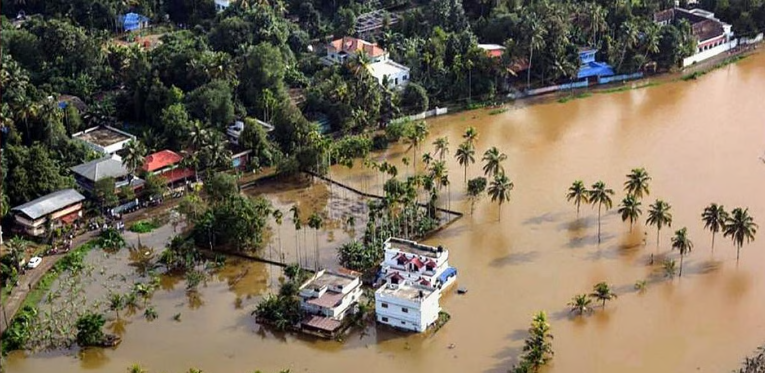
After the great floods of 2018, Keralites were relieved by the belief that they would not have to witness another major flood in the near future. However, post-2018, floods have become a recurring phenomenon in Kerala. In 2026, the banks of the Pamba and Manimala rivers were submerged in a manner similar to the 2018 deluge, causing loss of lives and severe damage.
When the major floods struck in 2018, we had no similar recent historical events for comparison. Therefore, experts and the media compared it to the great flood of 1924 (1099 in the Malayalam calendar, known locally as the “Thollayirathi Thonnootti Ompathile Vellappokkam” or the ’99 Flood). We now describe the floods of 1924 and 2018 as “floods of the century.” In the technical sense of a flood occurring once in a century, it was described using the term “100-year flood.” It was a phrase that offered us a sense of comfort, implying an event that happens only once every hundred years.
However, Kerala has faced consecutive floods since 2018. Does this indicate that the technical term ‘100-year flood’ is incorrect? The answer is no. When this was discussed in 2018, the mistake lay in the fact that we had no immediate preceding flood to look at, and the 94-year gap between the prior flood and 2018 aligned closely with the “100 years” in the term, leading us to misconstrue its actual meaning.
In reality, the technical term “100-year flood” does not mean a flood that happens once every century. Instead, it is a technical phrase used in flood mapping to denote a 1% probability of a flood occurring in any given year. Although we have long used the name “flood of the century,” scientists more accurately refer to it in scientific language as a “1% annual exceedance probability flood.” Similarly, if the probability of flooding is 2%, it is called a 50-year flood. When it is 5%, it is called a 20-year flood. A 20-year flood means that the flood risk in that area is five times higher than that of the commonly referenced 100-year flood. It is collectively known as the Flood Exceedance Probability (FEP).
To put it simply, suppose the probability of getting heads when tossing a coin is 50%. This does not mean heads cannot appear twice in a row, there is still a 25% chance for that to happen. Similarly, the phenomenon of a 100-year flood does not mean one must wait 100 years for it to occur; rather, there is a 1% chance of it happening in any given year. This means that in any year, the probability of a flood of that magnitude or greater occurring remains at 1%. Thus, the severe flood of 2018 does not reduce the likelihood of flooding in subsequent years to zero.
A 100-year flood is determined by calculating the peak flow rate that causes flood elevations in rivers. This conclusion is reached using flood modeling software to analyze statistical data derived from historical river discharge rates or maximum rainfall amounts. Areas delineated this way are called 100-year floodplains. Saying a region is a “100-year floodplain” means that it is an area where water from a flood with a 1% annual probability is expected to reach.
Explaining this in the context of Kerala, studies evaluated the August 2018 flood as roughly equivalent to a 100-year flood event. Before that, the previous flood of similar magnitude in Kerala occurred in 1924. There was an exact 94-year gap between 1924 and 2018. Generally speaking, it was an event with a 1% annual probability. Flooding struck Kerala again in 2019 and 2026, with several non-trivial floods in between. Moreover, these floods were reported in the very same areas that had been submerged earlier. These events served as evidence to correct the misconception that “a 100-year flood will not repeat soon.”
Kerala has a very unique topography. Steeply sloped mountain ranges, 44 rivers, and high-intensity rainfall over short durations in the Western Ghats make Kerala particularly vulnerable. When calculating the 100-year flood levels in Kerala, scientists cannot rely solely on river discharge rates or simple rainfall volumes; they must also account for factors like the presence of dams on rivers, and the encroachment of traditional rainwater retention systems (like paddy fields and wetlands) and riverbanks. The reduced natural width of rivers and shallow beds caused by silt accumulation further increase the risk of flooding.
Studies including 100-year flood estimation and flood risk mapping have become indispensable for Kerala’s future. Such research is crucial for ensuring that infrastructure like roads and buildings in currently flood-prone areas are elevated above the designated flood line, and for enabling the State Disaster Management Authority to plan evacuations in advance. Considering the rapidly changing climate and the safety of human lives in low-lying coastal and riverine regions, these are not merely academic studies for Kerala, but an urgent necessity for preserving human lives.