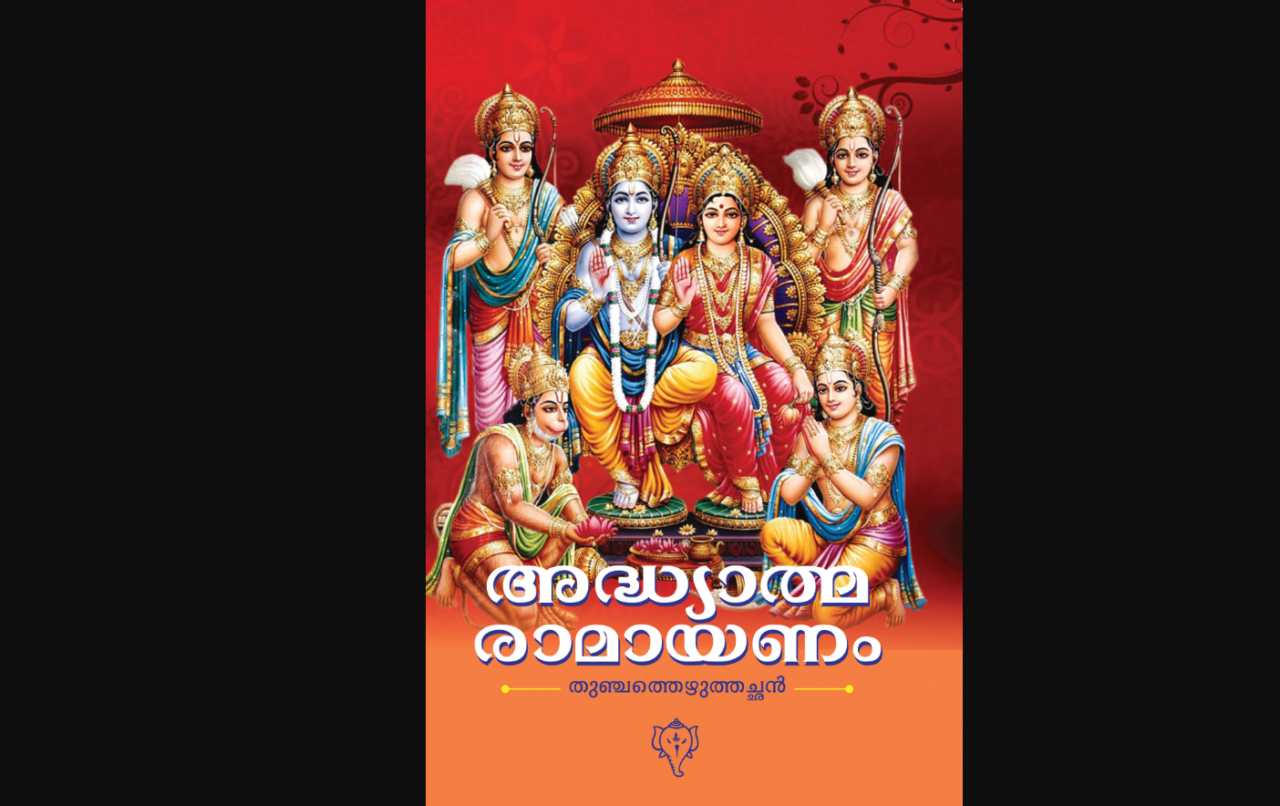
For the people of Kerala, the Adhyatma Ramayanam is not merely a guide to spiritual liberation but also a handbook for righteous living. The influence of the story of Sri Rama on our language, creativity, cultural life, values, and ideals is immeasurable. The annual observance of the Ramayana month has played a significant role in renewing and reorienting these elements in every generation. At one time, people in Kerala used the month-long observance of Ramayana reading as a spiritual preparation for shaping their New Year resolutions (as per Malayalam calendar) and life goals in accordance with Dharma.
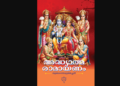
Among the many contributions of Thunchathu Ramanujan Ezhuthachan, the author of the Adhyatma Ramayanam Malayalam, perhaps the most significant was the preservation of Kerala’s Hindu cultural identity through centuries of colonial invasions and upheavals. The Malayalam language sailed through numerous cultural challenges aboard the vessel of the Ramayana. Just as the Supreme Poet, who created the universe, concealed the vast banyan tree within a tiny seed, Thunchathu Acharyan, at a time when Dharma faced grave decline, infused Sanatana Dharma and the wisdom of the sages into the story of Rama and wrapped the language itself in the Ramayana and preserved it for the generations to come. The reason no force could destroy the language or the civilization it carried was that Thunchathu Acharyan anchored their very soul in the timeless Rama Katha. That is the reason why the 16th century poet is popularly known as the father of modern Malayalam language.
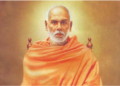
For generations, Malayalis have regarded the Ramayana as a means of self-purification. How did people in Kerala practice Ramayana recitation a century ago? How popular was the text among ordinary people? To what extent was the concept of Sri Rama rooted in local tradition? These are some of the questions that arise every Ramayana month. Interestingly, many of the answers can be found through the life and teachings of Sree Narayana Guru. This brief inquiry may also help clarify the relationship between Sree Narayana Guru and the Ramayana for those who wonder whether any such connection existed.
“The Divine in Human Form?”
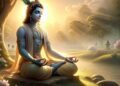
Chronologically, Sree Narayana Guru was born three centuries after Thunchathu Ezhuthachan. Through his divine message, “One caste, one religion, one God for humanity” and its many interpretations, Guru Devan unequivocally proclaimed to the modern age that God exists. For Sree Narayana Guru, Sri Rama was indeed God in human form.
In the Anukampa Dasakam, alongside Bhagwan Sri Parthasarathi (Bhagwan Sri Krishna) who delivered the Bhagavad Gita, Guru praises Bhagwan Sri Rama, the human incarnation of the Supreme Being, as the embodiment of compassion. Authoritative interpreters of Guru’s works, including Dr. T. Bhaskaran and Swami Muni Narayana Prasad, affirm that the phrase “God in human form” in the hymn refers specifically to Sri Rama.1&2 In Anukampa Dasakam, while Guru refers to many figures as sons or messengers of God, the only one he identifies as the direct incarnation of the God is Bhagwan Sri Rama.
Gurudevan, who wrote “Dharma Eva Param Daivam” (Dharma itself is the Supreme God) 2 naturally juxtaposed that concept of Dharma with the classical description, “Ramo Vigrahavan Dharma” (Rama is Dharma embodied). Thus, Sri Rama became, in Guru’s understanding, ‘God manifest in human form’.
Given that Guru consecrated temples dedicated to numerous Hindu deities across Kerala, it is conceivable that he might also have consecrated a temple for Sri Rama. On one occasion, when devotees requested him to establish a temple, Guru suggested installing a lamp symbolizing Goddess Lakshmi instead of an idol. The devotees replied that people desired a visible idol of worship. Guru then proposed placing portraits of great souls around the lamp, and among the figures he recommended was Sri Rama.
In another conversation, Guru remarked that both the concepts of Shiva and Sri Rama were part of the earliest forms of tribal worship in the region. He observed:
“Our (my) view is that Shiva, Sri Rama, and others were leaders of their respective times. We (I) think Sri Rama may have belonged to a warrior community (which was prevalent even in South India). Because he was courageous and beneficial to society, people praised him and gradually elevated him to the status of a divine being possessing all virtues.”4
This observation is significant because it illustrates how historical heroes and traditionally worshipped deities become interconnected in Hindu religious practice. By identifying Sri Rama as a revered figure within the South Indian regional traditions, Guru’s perspective also serves as a response to claims that Sri Rama was never part of Kerala’s native devotional culture. Guru regarded both Sri Shiva and Sri Rama as integral deities of the land.
How Should the Ramayana Be Read?
Guru also shared valuable information about the tradition of Ramayana recitation in his time (the late 19th century). According to Kottukkoikkal Velayudhan, a disciple of Guru and a propagator of his teachings, it was customary to complete the entire Ramayana in a single day. Guru himself is said to have done so many times.
While discussing Kerala’s old customs, Guru once remarked:
“It was the common belief and understanding that completing the entire Ramayana in one day brought merit. I have read the Ramayana and finished it in a single day, and did so on many occasions.”5
Even today, many people complete multiple readings of the Adhyatma Ramayanam during the Malayalam month of Karkidakam (Shravana month). Though rare, there are still devotees who undertake continuous day-and-night recitations and complete the text within twenty-four hours, thus preserving this older tradition.
Guru also emphasized that the Ramayana should be read with understanding. A story from his wandering ascetic years illustrates this point. Kottukkoikkal Velayudhan records an incident involving Sri Kesavan Vaidyar of Iravankara near Mavelikkara.6 One day, while Vaidyar and his friends were reading the Ramayana, a radiant mendicant approached them. Wanting to test him, they asked whether he could explain the meaning of the text.
As a test, they handed him the section known as Lakshmanopadesham. Soon after he began reading, the depth of his interpretation and the beauty of his language astonished the listeners. Realizing they were in the presence of an extraordinary soul, they attempted to honor him with gifts and hospitality, but he declined and quietly departed. Years later, when Kesavan Vaidyar met Sree Narayana Guru in Karunagappally, he realized that the mysterious ascetic had been Guru himself.
Such episodes from Guru’s life vividly demonstrate the widespread popularity of the Ramayana and devotion to Sri Rama among both saints and ordinary Keralites, especially among non-Brahmin communities, a century ago.
The Maharamayana and Mahasamadhi
Another text closely connected with the story of Sri Rama is the Yoga Vasistha (also known as Jnana Vasistha), which records the spiritual teachings given by Sage Vasistha to Sri Rama. This profound philosophical work accompanied Guru throughout his life. This holy text is also popularly known as Maharamayana. Many authoritative biographers note that the Yoga Vasistha was among Guru’s most cherished texts. V. Bhargavan Vaidyar records that Guru often listened to disciples reading aloud from the Yoga Vasistha and the Bhagavad Gita.7
Significantly, on the day of his Mahasamadhi, Guru listened to the Jivanmukti Prakarana section of the Yoga Vasistha, which describes liberation while living. Kottukkoikkal Velayudhan records:
“At the time of Samadhi, Sri Vidyananda Swami was reading the Jivanmukti section of the Yoga Vasistha in Guru’s presence. Listening to that portion describing liberation, Guru entered deep meditation and attained Mahasamadhi.”8
From his wandering ascetic years until his final moments, few texts occupied as central a place in Guru’s spiritual life as those associated with the story of Rama.
Despite this, some groups continue to portray Sree Narayana Guru as standing in opposition to Sri Rama. Those who advance this argument usually cite a single remark concerning the episode of Shambuka’s death in the Uttara Ramayana. They point to Guru’s rhetorical observation, “Does not the Ramayana say that Shudras were forbidden from taking sannyasa even in Rama’s time?” as though it alone defines his view of Sri Rama.
The evidence presented above makes it clear that this was not the totality of Guru’s reflections on the subject.
How, then, should such claims be assessed? The guiding principle must be Guru’s unequivocal affirmation that God exists. The interpretive tradition established by Nataraja Guru and other disciples of Sree Narayana Guru provides the appropriate framework. Those who distort Guru’s teachings to validate political or atheistic ideologies should first be asked a fundamental question:
“Do you accept Guru’s affirmation that God exists?” If the answer is no, it becomes difficult to claim a faithful understanding of Guru’s thought. Arguments, misinterpretations, and distortions that are inconsistent with the available evidence deserve to be set aside.
The melody, poetry, and charm of Ezhuthachan’s Ramayana have survived four centuries and multiple waves of cultural intrusion, continuing their triumphant journey even in the age of artificial intelligence. It was through the divine voices of great spiritual figures like Sree Narayana Guru that the story of Rama flowed into our own generation. Each Ramayana month, as we pass on the endlessly captivating tales of Rama to the next generation, what we truly transmit are our Dharma, language, culture, and identity. When asked, “Whose Rama?” every Hindu in Kerala should be able to answer: “The Rama of Sree Narayana Guru.”
References:
1. Bhaskaran, T. Complete Works of Sree Narayana Guru (Malayalam). Mathrubhumi Books, Kozhikode, 1985, p. 511.
2. Muni Narayana Prasad. Complete Works of Sree Narayana Guru (Malayalam), Vol. III. DC Books, Kottayam, 2019, p. 790.
3. Dharma, Sree Narayana Guru.
4. Balakrishnan, Shyam. Maunappoonthen (Malayalam). One World University, Wayanad, 2015, p. 39.
5. Velayudhan Kottukkoikkal. Sree Narayana Guruvum Sishyanmarum (Malayalam). Sree Narayana Press, Kollam, 1970, p. 170.
6. Ibid., p. 169.
7. V. Bhargavan Vaidyar. Sree Narayana Guruvum Sishyanmarum (Malayalam). Gayathri Ashram, Chalakudy, 2014, p. 120.
8. Kottukkoikkal Velayudhan. Sree Gurudeva Smaranakal (Malayalam). S.N. Press, Kollam, 1975, p. 240.
(The author is a writer and Fellow at the Centre for South Indian Studies.)