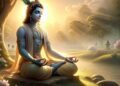
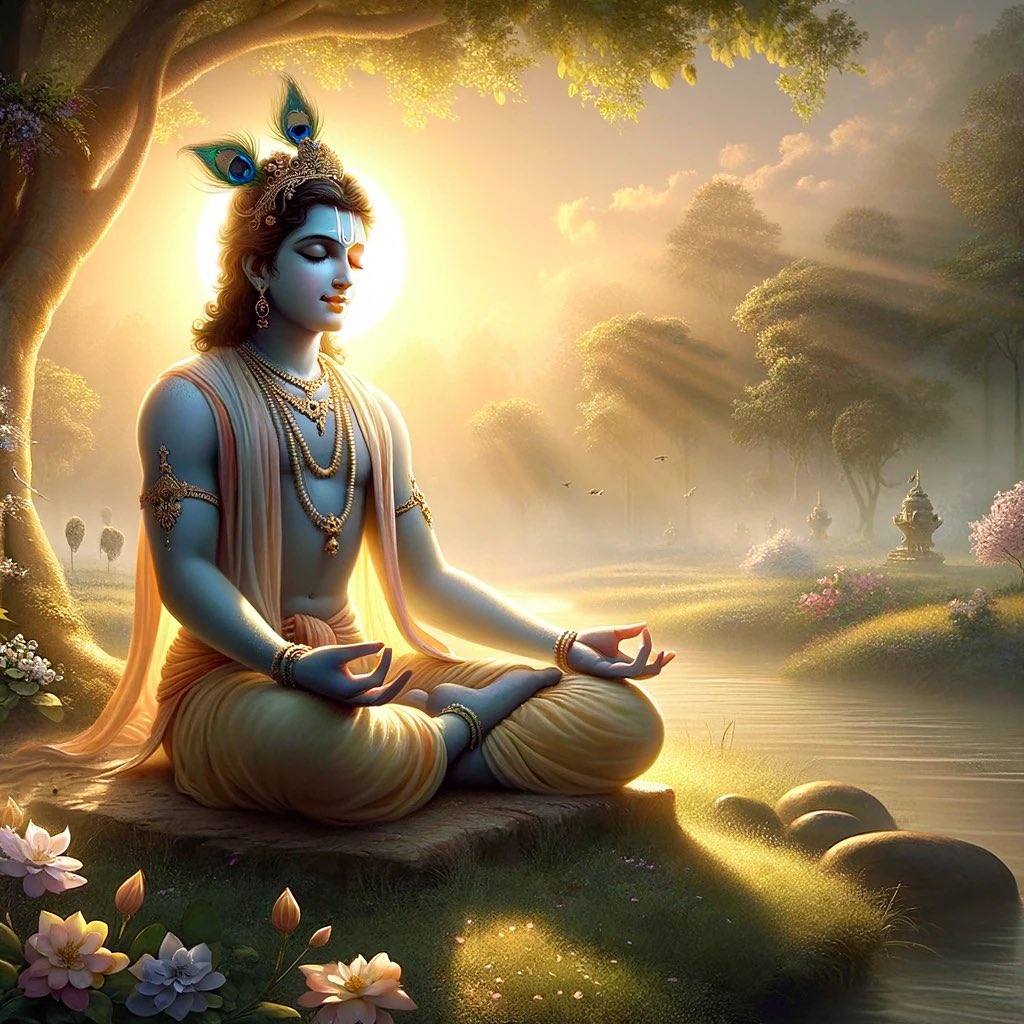
Though not regarded as an authority on Sanatana Dharma, Osho Rajneesh possessed a deeply creative personality whose insights often draw our attention through their sheer originality. Presenting Sri Krishna as the ultimate representation of Pure Consciousness, Osho once remarked: “He can happen at any date and time; he will be relevant to any time and situation. He will have no difficulty whatsoever in being what he is; he will be the same in all times.” This ever-present potential that is capable of manifesting anywhere, in the Dwapara Yuga as readily as in the Kali Yuga, is precisely what Maharshi Vyasa named “Sri Krishna.” When Osho notes that Krishna is not confined to any space or situation, like the Mathura or Kurukshetra of antiquity, but represents an internal awakening that can bloom within any prepared soul regardless of time or space, his words echo the insight of a poet recognizing Vyasa’s embodiment of pure consciousness.
The First Krishna Darshana in the Mahabharata
Sri Krishna makes his first appearance in the Mahabharata on the occasion Draupadi’s Swayamvara in the Adi Parva. While Vyasa paints several other characters with elaborate imagery and heroic grandeur, he introduces Sri Krishna without fanfare, as a character lost amidst the crowd. Seated quietly at the edge of the assembly alongside his elder brother Balarama, Sri Krishna is merely an invited guest, observing the ceremonies in Panchala as a detached witness. Yet, he is the first to spot the Pandavas, who have attended the gathering disguised as Brahmins. When an unknown “Brahmin” wins Draupadi’s hand, inciting the enraged Kshatriyas to draw their swords in protest, Krishna remains composed, quietly identifying the disguised Pandavas. Krishna calmly tells Balarama: “Without a doubt, brother, that is Arjuna, if I am indeed Krishna.”
This moment marks a pivotal turning point in the epic. It is at this very stage that the Pandavas earn the hostility of many who would later line up against them on the battlefield of Kurukshetra. Simultaneously, it is here that Sri Krishna, the master of Yoga and their ultimate ally and master, quietly recognizes them before they even realize his presence. Therein lies the profound significance of Krishna’s first appearance in the Mahabharata.
The twentieth century set out with the philosophical declaration that "God is dead," yet humanity continues to ask whether God exists. In response, Sree Narayana Guru, Sri Aurobindo, Sree Chattampi Swamikal, Sri Ramakrishna Paramahamsa, etc. declared unequivocally that God exists, bearing witness through their direct experiences. Every Janmashtami renews this awakening, reminding us that Lord Sri Krishna lives beyond time and space. From Veda Vyasa to the modern seers, their voice calls out across the ages: "The Divine exists; therefore, serve Dharma."
The divinity of Krishna comes to its fullness in the epic during the discourse of the Bhagavad Gita. Celebrated as the essence of the Vedas and the science of Yoga, the Gita imparts the wisdom of Brahma Vidya (knowledge of the Supreme Self). Delivered to Arjuna as a disciple, the world reveres this teaching as both an Upanishad and a sacred Smriti text for all humanity. The Krishna who taught Yoga to Arjuna in Dwapara Yuga continues to manifest ceaselessly as the Divine guiding modern rishis and yogis. How deeply have we recognized Krishna’s contemporary presence? Who are the modern yogis who bore witness to the manifestation of the Lord in the 19th and 20th centuries?
This inquiry leads us to two profound spiritual figures of recent times: Sree Narayana Guru and Sri Aurobindo. Both were great Yogis who radically transformed modern Bharat’s spiritual and intellectual landscape, and for both, their primary experience of the Divine came as a vision of Sri Krishna. Beyond the vision itself, there is an extraordinary parallel in how both masters translated this experience into the written word: each penned his encounter by hand, choosing the medium of sonnet, a single-stanza poem or sonnet—a Muktaka.
Krishna manifests to Sree Narayana Guru
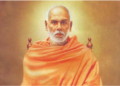
As we know, Sree Narayana Guru was a great sage whose life spanned the 19th and early 20th century Kerala. His contributions to the Dharmic renaissance in Kerala are a subject of deep study and research. As a young student, in 1870s, Sree Narayana Guru traveled to a village called Kayamkulam to pursue higher studies under a Sanskrit scholar Kummampilli Raman Pillai Asan. The Guru was in his early twenties at the time and resided at Varanappalli, a renowned Ezhava ancestral home. Biographers consistently depict the Guru during this period as an ardent devotee of Sri Krishna. Biographers like Kottukoikkal Velayudhan record that elder women of the Varanappalli household, traditionally devoted to Shiva, became devotees of Krishna, under the spiritual influence of the young Guru. During this period, Guru composed several devotional hymns to Sri Krishna for these mothers, including the Gajendramoksham Ammanappattu, though many of these works have regrettably been lost to time.
It was during this pivotal phase that the Guru was graced with his first direct vision of Sri Krishna, a spiritual encounter he later recounted to many people including E. K. Ayyakkutti, a district judge and social activist.
To capture this indescribable experience, the Guru composed a poem titled Sri Krishna Darsanam. Though he also wrote traditional Vaishnava hymns like the Vishhvashtakam and Sree Vasudevashtakam, Sri Krishna Darsanam stands entirely apart in structure, tone, and philosophical depth. Written in the Sardulavikridita meter, the verse reads:
Bhooyovruṭṭi Nivrruṭṭayaaybbhuvanavum-
Satṭil Tirobhootamaay
Peeyooṣhadhvanileenamaaychuzhalavum
Sobhiccu deepaprabha,
Maayaamoodupaṭam ṭurannu maṇiraṅgaṭṭil
Prakaaśikkumakkaayaavin
Malarmeeni kausṭubhamaṇigreevanṭe divyoṭsavam.
As scholars like Dr. T. Bhaskaran elucidates the meaning of this verse:
“The cycle of rebirth came to an end; the world dissolved into Pure Being. All surrounding sound merged into an ambrosial harmony, and an immense (radiant) light shone all around. Tearing open the veil of Maya, the dark-hued form of Krishna, adorned with the Kaustubha gem upon his neck, shone forth upon the jewel-decked stage like a divine festival.”
From our perspectives, the Guru’s poem traces a journey from the unmanifest realities of Nirguna realization to the personal radiance of Saguna worship. For the Guru, the vision of Sri Krishna marked the complete cessation of mental modifications (vritti). The objective world dissolved, and the clamor of the internal realm fell silent. The Guru articulates this divine revelation by binding it to an infinite, transcendent light. Swami Muni Narayana Prasad, a prominent commentator on the Guru’s works, observes that this Muktaka flowed forth as the verbal manifestation of a transcendent experience, noting that the verse resists conventional commentary, an insightful and honest assessment.
Sri Aurobindo’s Vision of Krishna
While Sree Narayana Guru’s vision was a natural evolution along his spiritual path, for Sri Aurobindo, a revolutionary, intellectual, poet, and writer, it served as the catalyst for a total inner transformation. During his leadership in the Bengal freedom movement, Sri Aurobindo was arrested in connection with the notorious 1908 Alipore Bomb Case. While confined in Alipore Jail, his life underwent a profound shift. Within the cell, the revolutionary beheld Lord Sri Krishna. It was this divine vision that redirected him from political struggle to intensive spiritual practice (sadhana) and the propagation of Sanatana Dharma.
He later revealed this realization in his famous Uttarpara Speech through his characteristic poetic prose:
“I walked under the branches of the tree in front of my cell but it was not the tree, I knew it was Vasudeva, it was Sri Krishna whom I saw standing there and holding over me his shade. I looked at the bars of my cell, the very grating that did duty for a door and again I saw Vasudeva. It was Narayana who was guarding and standing sentry over me. Or I lay on the coarse blankets that were given me for a couch and felt the arms of Sri Krishna around me, the arms of my Friend and Lover. This was the first use of the deeper vision He gave me.
I looked at the prisoners in the jail, the thieves, the murderers, the swindlers, and as I looked at them I saw Vasudeva, it was Narayana whom I found in these darkened souls and misused bodies. Amongst these thieves and dacoits there were many who put me to shame by their sympathy, their kindness, the humanity triumphant over such adverse circumstances.
One I saw among them especially, who seemed to me a saint, a peasant of my nation who did not know how to read and write, an alleged dacoit sentenced to ten years’ rigorous imprisonment, one of those whom we look down upon in our Pharisaical pride of class as Chhotalok. Once more He spoke to me and said, “Behold the people among whom I have sent you to do a little of my work. This is the nature of the nation I am raising up and the reason why I raise them.”
When the case opened in the lower court and we were brought before the Magistrate I was followed by the same insight. He said to me, “When you were cast into jail, did not your heart fail and did you not cry out to me, where is Thy protection ? Look now at the Magistrate, look now at the Prosecuting Counsel.”
I looked and it was not the Magistrate whom I saw, it was Vasudeva, it was Narayana who was sitting there on the bench. I looked at the Prosecuting Counsel and it was not the Counsel for the prosecution that I saw; it was Sri Krishna who sat there, it was my Lover and Friend who sat there and smiled. “Now do you fear ?” He said, “I am in all men and I overrule their actions and their words. My protection is still with you and you shall not fear. This case which is brought against you, leave it in my hand. It is not for you. It was not for the trial that I brought you here but for something else. The case itself is only a means for my work and nothing more.””
Sri Aurobindo frequently referenced this experience in his notes and letters with deep spiritual ecstasy. Like Sree Narayana Guru, Sri Aurobindo captured his jailhouse vision in a sonnet titled Krishna:
At last I find a meaning of soul’s birth
Into this universe terrible and sweet,
I who have felt the hungry heart of earth
Aspiring beyond heaven to Krishna’s feet.
I have seen the beauty of immortal eyes,
And heard the passion of the Lover’s flute,
And known a deathless ecstasy’s surprise
And sorrow in my heart for ever mute.
Nearer apd nearer now the music draws,
Life shudders with a strange felicity;
All Nature is a wide enamoured pause
Hoping her lord to touch, to clasp, to be.
For this one moment lived the ages past;
The world now throbs fulfilled in me at last.
The majestic language rising from the depths of Sri Aurobindo’s soul defies easy translation. Just as Swami Muni Narayana Prasad hesitated to dissect Guru’s single verse, the most fitting posture before Sri Aurobindo’s genius is one of reverent silence.
Following his confinement in Alipore, Sri Aurobindo began to perceive Krishna in every living being around him. The bliss he described in his speech is articulated with refined precision in his poetry. Meanwhile, Guru’s biographer Moorkoth Kumaran records that Sree Narayana Guru experienced a remarkably similar state of bliss: the young Nanu Asan saw the child Krishna, Sri Balagopal, along every path he walked, in the yards, fields, streams, and ponds. The Guru himself noted that Krishna appeared to him continuously, both in waking states (Jagrat) and in dreams (Swapna). Both seers remind us that living the Yajurvedic verse, “Isha vasyam idam sarvam” (All this is enveloped by the Divine), defines the true meaning of religion within Sanatana Dharma. For why else would liberated souls (Jivanmuktas) choose to record such experiences in human language?
In another short poem also titled Krishna, Sri Aurobindo offers further clarity on his personal realization, describing a radiant light identical to the Deepaprabha (immense light) witnessed by Sree Narayana Guru:
O immense Light and thou, O spirit-wide boundless Space,
Whom have you clasped and hid, deathless limbs, gloried face?
Vainly lie Space and Time, “Void are we, there is none.”
Vainly strive Self and World crying, “I, I alone.”
One is there, Self of self, Soul of Space, Fount of Time,
Heart of hearts, Mind of minds, He alone sits, sublime.
Oh, no void Absolute self-absorbed, splendid, mute,
Hands that clasp hold and red lips that kiss blow the flute.
All He loves, all He moves, all are His, all are He!
Many limbs sate His whims, bear His sweet ecstasy.
Two in One, Two who know difference rich in sense,
Two to clasp, One to be, this His strange mystery.
Here, Sri Aurobindo paints the dual and non-dual states of consciousness—becoming “Two in One” in experience, yet remaining “One” in absolute essence. Another philosophical parallel between Sri Aurobindo and Narayana Guru lies in their refusal to renounce the external world upon attaining divine vision. When the veil of illusion drops, the divine presence of Sri Krishna reveals itself everywhere. While Krishna represents a divine hero and the pinnacle of beauty for the Guru, He is a friend and inner inhabitant for Sri Aurobindo. Devotion, joy, beauty, and wonder weave seamlessly through the words of both seers; indeed, one can easily discern a divine convergence of Sri Aurobindo’s twin poems within the Guru’s single Muktaka.
Sri Aurobindo’s poetry often resists simple translation, as evidenced by his spiritual epic Savitri. Though translated many times, few renderings capture the resonance of the original text. The same linguistic mastery and poetic precision shine through Sree Narayana Guru’s verse. Osho once observed that a yogi who experiences the Divine must also be a great poet, at least of the caliber of Kahlil Gibran, to translate the transcendental experience into words, noting that most enlightened beings remain silent or lack poetic expression. Yet such reservations fall away here. Sri Aurobindo, who synthesized the paths of Jnana, Bhakti, Raja, and Karma Yoga into Integral Yoga, and Sree Narayana Guru, who realized supreme Truth through Vedanta, both experienced the vision of Sri Krishna as a direct, living reality. Both were extraordinary poets capable of outshining the literary figures and great poets of their times. By capturing the divine essence in verse without losing its spiritual brilliance, both sages created enduring testimonies of truth. Their poems remain living witnesses that God abides eternally with those who serve Dharma.
The twentieth century set out with the philosophical declaration that “God is dead,” yet humanity continues to ask whether God exists. In response, Sree Narayana Guru, Sri Aurobindo, Sree Chattampi Swamikal, Sri Ramakrishna Paramahamsa, etc. declared unequivocally that God exists, bearing witness through their direct experiences. Every Janmashtami renews this awakening, reminding us that Lord Sri Krishna lives beyond time and space. From Veda Vyasa to the modern seers, their voice calls out across the ages: “The Divine exists; therefore, serve Dharma.”