

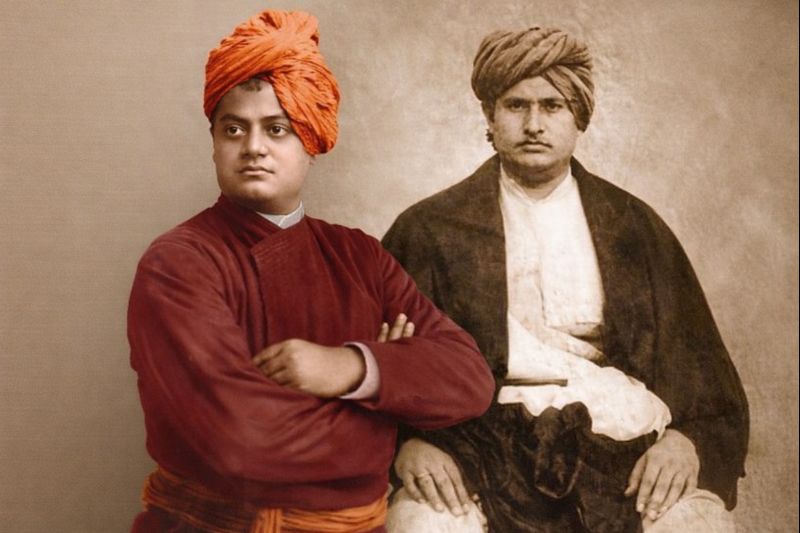
Maharshi Dayananda Saraswati and Swami Vivekananda stand as two towering spiritual personalities who contributed immensely to the reformation and revitalization of Sanatana Dharma in the nineteenth century. Although they lived and preached during the same historical period, the influence, reach, and impact of their work have continued to expand and permeate the twenty-first century and beyond. While both occupy central positions in the modern revival of Sanatana Dharma, there is limited scope for direct comparison between them, given the distinct paths they pursued and the differing foundations of their spiritual and intellectual training. The nineteenth century was marked by a profound erosion of Hindu Dharma, as numerous adharmic influences dominated not only the spiritual domain but also the social fabric of Indian society. In response, both Maharshi Dayananda and Swami Vivekananda sought to revive Hindu Dharma by returning to the broader Vedic Parampara. Each inspired the masses—both overtly and covertly—against British colonial domination and envisioned the reconstruction of a new Bharat grounded in its civilizational ethos and indigenous values. Despite apparent differences in method and emphasis, both shared a common vision of a strong, self-reliant Bharat and the holistic progress of its people.
Maharshi Dayananda Saraswati attained Mahasamadhi in 1883, at a time when the young Narendra Nath Datta had not yet completed his Bachelor’s degree. Consequently, Maharshi Dayananda had no opportunity to witness Swami Vivekananda’s later emergence as a major spiritual force and his decisive role in the Hindu renaissance. Swami Vivekananda, however, studied Maharshi Dayananda’s teachings with keen interest and seriousness, a fact clearly reflected in The Complete Works of Swami Vivekananda. On numerous aspects of Dharma, Swami Vivekananda drew extensively from Maharshi Dayananda Saraswati’s ideas and consistently regarded him as one of the great saints of his age. There were also occasions when Swami Vivekananda worked in association with the Arya Samaj. This article therefore seeks to examine Swami Vivekananda’s engagement with Maharshi Dayananda’s teachings—highlighting the areas where he agreed, where he differed, and where he expressed admiration for Maharshi Dayananda’s scholarship.
While the two thinkers share several points of convergence, their differences are equally significant and warrant careful examination. Swami Vivekananda was deeply influenced by Western philosophy and modern education, which enabled him to articulate Hindu thought to Western audiences and Western-educated Indians in a language and conceptual framework familiar to them. However, for various reasons, this background also limited his engagement with the Vedas in their original form. Swami Vivekananda was not trained in traditional Vedic Sanskrit and did not study the Vedas through the classical Gurukul system. In contrast, Maharshi Dayananda Saraswati inherited the Vedic tradition through rigorous traditional education and remained entirely outside the influence of colonial academic frameworks. Swami Vivekananda’s views on the Veda Samhitas might have differed had he been exposed to them through unbiased and traditional sources. Instead, his understanding was shaped largely by English translations of the Vedas and Upanishads produced by scholars such as Max Müller and Paul Deussen, translations that were themselves constrained by philological limitations and interpretive biases.
Samhita vs Upanishads: The True Source of Infallible Truth
In a broader context, Swami Vivekananda represented Hindu orthodoxy while maintaining a reformist and progressive outlook. However, Maharshi Dayananda Saraswati’s clarity and precision on Dharmic principles and practices stand in stark contrast to Vivekananda’s position. Maharshi Dayananda placed the Veda Samhitas above all scriptures, regarding them as the sole and ultimate source of knowledge of the Supreme Being and the only valid Pramana of Dharma. Swami Vivekananda, on the other hand, held the Upanishads in higher esteem, believing them to contain the highest spiritual knowledge.
In a letter dated June 1, 1897, Swami Vivekananda explains that the commonly accepted meaning of the word Veda includes three parts: the Samhitas, the Brahmanas, and the Upanishads. He writes:
“The objections you show about the Vedas would be valid if the word Vedas meant Samhitâs. The word Vedas includes the three parts, the Samhitas, the Brâhmanas, and the Upanishads, according to the universally received opinion in India. Of these, the first two portions, as being the ceremonial parts, have been nearly put out of sight; the Upanishads have alone been taken up by all our philosophers and founders of sects,” Swamiji writes.
Swami Vivekananda further observes that the view that the Samhitas alone constitute the Vedas was introduced by Maharshi Dayananda Saraswati and had not gained acceptance among orthodox Hindus. He critically notes Dayananda’s attempt to derive a consistent religious system exclusively from the Samhitas while acknowledging the unresolved difficulties involved.
“The idea that the Samhitas are the only Vedas is very recent and has been started by the late Swami Dayananda. This opinion has not got any hold on the orthodox population. The reason of this opinion was that Swami Dayanand thought he could find a consistent theory of the whole, based on a new interpretation of the Samhitas, but the difficulties remained the same, only they fell back on the Brahmanas. And in spite of the theories of interpretation and interpolation a good deal still remains.” (Source: The Complete Works of Swami Vivekananda Volume 5, Epistles – First Series, LXXVI).
At the same time, Swami Vivekananda suggests that if such consistency could be achieved from the Samhitas, it would be far more feasible to establish a harmonious and consistent faith based on the Upanishads, aligning with the national consensus and the teachings of earlier Acharyas.
“Now if it is possible to build a consistent religion on the Samhitas, it is a thousand times more sure that a very consistent and harmonious faith can be based upon the Upanishads, and moreover, here one has not to go against the already received national opinion. Here all the Âchâryas (Teachers) of the past would side with you, and you have a vast scope for new progress,” states Swamiji. (Source: The Complete Works of Swami Vivekananda Volume 5, Epistles – First Series, LXXVI).
It is important to note that Maharshi Dayananda Saraswati did not reject the Upanishads outright but denied them the status of being the primary and infallible source of truth. He viewed them as interpretations of the Veda Samhitas, which he upheld as Apaurusheya Shruti—eternal and not of human origin—while regarding the Upanishads as products of human intellect and philosophical reasoning.
Mahardhi Dayananda’s Association with the Theosophical Society and Swamiji’s Views
Maharshi Dayananda Saraswati’s brief association with the Theosophical Society (1878–1882) ended due to irreconcilable differences. Despite later criticism from Orxthodox Hindu leadership and Pauranikas, Swami Vivekananda clearly recognized that Maharshi Dayananda’s purity of intention. He said, Dayananda Saraswati had withdrawn once he discerned the true nature of the movement. Swami Vivekananda referred to Theosophy as an “Indian grafting of American Spiritualism” and praised Dayananda for decisively severing ties with it.
“We cannot attribute a knowledge of all this to the writer of the articles in the Advocate, but he must not confound himself and his Theosophists with the great Hindu nation, the majority of whom have clearly seen through the Theosophical phenomena from the start and, following the great Swami Dayânanda Sarasvati who took away his patronage from Blavatskism the moment he found it out, have held themselves aloof,” says Swami Vivekakanda. (Source: The Complete Works of Swami Vivekananda, Volume 4, Writings: Prose, STRAY REMARKS ON THEOSOPHY)
On Indian Womanhood: Vivekananda Echoes Maharshi Dayananda
Swami Vivekananda echoed Maharshi Dayananda’s views on the elevated position of women in Vedic society, attributing their later marginalization to post-Vedic, Puranic influences. In an 1898 Prabuddha Bharata interview, Swami Vivekananda quoted Maharshi Dayananda to distinguish women’s roles Vedic ritual practices and later idol-centric customs.
“But Swamiji!” said I — startled at an assertion so sweeping and so unexpected — “is Hinduism not an Aryan faith?”
“Modern Hinduism”, said the Swami quietly, “is largely Paurânika, that is, post-Buddhistic in origin. Dayânanda Saraswati pointed out that though a wife is absolutely necessary in the Sacrifice of the domestic fire, which is a Vedic rite, she may not touch the Shâlagrâma Shilâ, or the household-idol, because that dates from the later period of the Purânas.”
“And so you consider the inequality of woman amongst us as entirely due to the influence of Buddhism?”
“Where it exists, certainly,” said the Swami, “but we should not allow the sudden influx of European criticism and our consequent sense of contrast to make us acquiesce too readily in this notion of the inequality of our women. Circumstances have forced upon us, for many centuries, the woman’s need of protection. This, and not her inferiority, is the true reading of our customs.” ( The Complete Works of Swami Vivekananda, Volume 5, Interviews, On Indian Women — Their Past, Present And Future (Prabuddha Bharata, December, 1898))
Vivekananda on Dayananda’s Scholarship in Shastras
While discussing the authorship and commentarial history of the Bhagavad Gita and Vedanta Sutras, Swami Vivekananda repeatedly acknowledged Maharshi Dayananda’s deep engagement with the Bodhayana Bhashya. He also highlighted Dayananda’s insistence on textual authenticity.
“Now in the first place, let us see what grounds there are for such inquiry. We know that there were many who went by the name of Veda-Vyasa; and among them who was the real author of the Gita — the Bâdarâyana Vyasa or Dvaipâyana Vyasa? “Vyasa” was only a title. Anyone who composed a new Purâna was known by the name of Vyasa, like the word Vikramâditya, which was also a general name. Another point is, the book, Gita, had not been much known to the generality of people before Shankarâchârya made it famous by writing his great commentary on it. Long before that, there was current, according to many, the commentary on it by Bodhâyana. If this could be proved, it would go a long way, no doubt, to establish the antiquity of the Gita and the authorship of Vyasa. But the Bodhayana Bhâshya on the Vedânta Sutras — from which Râmânuja compiled his Shri-Bhâshya, which Shankaracharya mentions and even quotes in part here and there in his own commentary, and which was so greatly discussed by the Swami Dayânanda — not a copy even of that Bodhayana Bhashya could I find while travelling throughout India. It is said that even Ramanuja compiled his Bhashya from a worm-eaten manuscript which he happened to find. When even this great Bodhayana Bhashya on the Vedanta-Sutras is so much enshrouded in the darkness of uncertainty, it is simply useless to try to establish the existence of the Bodhayana Bhashya on the Gita. Some infer that Shankaracharya was the author of the Gita, and that it was he who foisted it into the body of the Mahabharata.”
(The Complete Works of Swami Vivekananda/Volume 4/Lectures and Discourses/Thoughts on the Gita)
On another occasion, Swami Vivekananda talked about the same topic and again mentioned Maharshi Dayananda’s appreciation of Bhodhayana Bhashya on Vedanta Sutra.
“Now both Shankara and Ramanuja laid aside all claim to originality. Ramanuja expressly tells us he is only following the great commentary of Bodhâyana. भगवद् बोधायनकृतां विस्तीर्णां ब्रह्मसूत्रवृत्तिं पूर्वाचार्याः संचिक्षिपुः तन्मतानुसारेण सूत्राक्षराणि व्याख्यास्यन्ते। — “Ancient teachers abridged that extensive commentary on the Brahma-sutras which was composed by the Bhagavân Bodhayana; in accordance with their opinion, the words of the Sutra are explained.” That is what Ramanuja says at the beginning of his commentary, the Shri-Bhâshya. He takes it up and makes of it a Samkshepa, and that is what we have today. I myself never had an opportunity of seeing this commentary of Bodhayana. The late Swami Dayânanda Saraswati wanted to reject every other commentary of the Vyâsa-Sutras except that of Bodhayana; and although he never lost an opportunity of having a fling at Ramanuja, he himself could never produce the Bodhayana. I have sought for it all over India, and never yet have been able to see it. But Ramanuja is very plain on the point, and he tells us that he is taking the ideas, and sometimes the very passages out of Bodhayana, and condensing them into the present Ramanuja Bhashya. It seems that Shankaracharya was also doing the same. There are a few places in his Bhashya which mention older commentaries, and when we know that his Guru and his Guru’s Guru had been Vedantists of the same school as he, sometimes corn more thorough-going, bolder even than Shankara himself on certain points, it seems pretty plain that he also was not preaching anything very original, and that even in his Bhashya he himself had been doing the same work that Ramanuja did with Bodhayana, but from what Bhashya, it cannot be discovered at the present time.” (The Complete Works of Swami Vivekananda/Volume 3/Lectures from Colombo to Almora/The Vedanta in all its phases)
Interpolation: Agreement with “Great Swami Dayananda”
Swami Vivekananda openly agreed with Maharshi Dayananda’s position on scriptural interpolations, referring to him as the “great Swami Dayananda Saraswati” in his Reply to the Madras Address.
“Either in the sharp analysis of the Vaisheshikas, resulting in the wonderful theories about the Paramânus, Dvyanus, and Trasarenus, [7] or the still more wonderful analysis displayed in the discussions of the Jâti, Dravya, Guna, Samavâya, [8] and to the various categories of the Naiyâyikas, rising to the solemn march of the thought of the Sânkhyas, the fathers of the theories of evolution, ending with the ripe fruit, the result of all these researches, the Sutras of Vyâsa — the one background to all these different analyses and syntheses of the human mind is still the Shrutis. Even in the philosophical writings of the Buddhists or Jains, the help of Shrutis is never rejected, and at least in some of the Buddhistic schools and in the majority of the Jain writings, the authority of the Shrutis is fully admitted, excepting what they call the Himsaka Shrutis, which they hold to be interpolations of the Brahmins. In recent times, such a view has been held by the late great Swami Dayânanda Saraswati,” spoke Swami Vivekananda. (The Complete Works of Swami Vivekananda/Volume 4/Writings: Prose/Reply to the Madras address)
America as Pātāla
Swami Vivekananda humorously quoted Maharshi Dayananda’s interpretation of Pātāla as America, demonstrating his familiarity with Satyarth Prakash and his engagement with Dayananda’s geographical interpretations.
Swami Vivekananda, in introducing the lecturer Swami Saradananda, said:
“Ladies and Gentlemen,
The speaker of tonight just comes from America. As you all know here that America is for your country, although our countrymen, specially Swami Dayananda Saraswati, used to call this country as Patal, inhabited by Laplands, Rakshas and Asurs, &c. (Laughter and loud cheers). Well, Gentlemen, whether it is Patal or not you ought to decide that by seeing those few ladies present here, who have come from the country of your so called Patal, whether they are Naga Kanyas or not. (Cheers). Now, America is perfectly a new country. It was discovered by Columbus, the Italian, and before that a prior claim is put forward by the Norwegians who say, that they have discovered the northern part of it, and then before that there is another prior claim of the Chinese, who at one time preached the noble doctrine of Buddhism in all parts of the world, and it is said that Buddhist Missionaries were also sent from India to America, and specially in Washington, where some sort[s] of records are still to be traced by any traveller going there. Well, the table has now been turned at last for a century or more and instead of America being discovered, she discovers persons that go over to her. (Loud applause). It is a phenomenon that we observe every day there, multitudes of persons coming over from every part of the country [world?] and getting themselves discovered in the United States. It is a fact, well known to you here all that several of our own countrymen have been discovered in that way. (Cheers). To day, here I present before you one of your Calcutta boys, that has been similarly discovered by the Americans. (Cheers).” (Source: The Indian Mirror, April 24, 1898)
Vivekananda and the Arya Samaj
There are several references to the connections and associations of Swami Vivekananda with the Arya Samaj, founded by Maharshi Dayananda Saraswati. In Swamiji’s well-known book Lectures from Colombo to Almora, which is based on the lectures he delivered in Sri Lanka and Bharat after his return from the West in 1897, there is a speech delivered at Lahore titled The Common Bases of Hinduism. Notably, the Arya Samaj played a key role in organizing the warm reception accorded to Swami Vivekananda at Lahore. In the introductory note to this speech, it is recorded:
“On his arrival at Lahore the Swamiji was accorded a grand reception by the leaders, both of the Ârya Samâj and of the Sanâtana Dharma Sabhâ. During his brief stay in Lahore, Swamiji delivered three lectures. The first of these was on ‘The Common Bases of Hinduism’, the second on ‘Bhakti’, and the third one was the famous lecture on ‘The Vedanta’.”
In a letter addressed to Swami Akhandananda, a direct disciple of Sri Ramakrishna Paramahamsa, Swami Vivekananda urged him to establish contact with the Arya Samaj at Lahore. Although the precise context of this instruction is unclear, Swamiji specifically asked him to trace the whereabouts of an Arya Samaj sannyasin named Swami Achyutananda. At that time, Swami Akhandananda was stationed in Rajasthan. Swamiji writes:
“Teach against the marriage of boys. No scripture ever sanctions it. But for the present say nothing against little girls being married. Directly you stop the marriage of boys, that of girls will stop of itself. Girls surely are not going to marry among themselves! Write to the Secretary, Arya Samaj, Lahore, asking the whereabouts of a Sannyasin named Achyutananda who used to live with them. Make special inquiry of the man. . . . Never fear.” (The Complete Works of Swami Vivekananda, Volume 6, Epistles – Second Series, LXXXV)
This letter suggests that the Ramakrishna Mission and the Arya Samaj may have worked together, and maintained coordination, on certain issues related to Dharma and other national issues.
In another speech titled The Social Conference Address, Swami Vivekananda openly acknowledges and praises the Arya Samaj, delivering a powerful reflection on the tradition of sannyasins in the world. He begins the speech by referring to the sannyasin who founded the Arya Samaj, none other than Maharshi Dayananda Saraswati. Swamiji also describes the Arya Samaj as “the new strong movement in the Punjab which we take for granted…”. He states:
“Before us lies the inaugural address of Mr. Justice Ranade, voicing the reformatory zeal of the Indian Social Conference…
The last part, however, which offers advice as to the creation of a body of teachers for the new movement strong in the Punjab, which we take for granted is the Ârya Samâj, founded by a Sannyâsin, leaves us wondering and asking ourselves the question: It seems God created the Brâhmin, God created the Kshatriya, but who created the Sannyasin?” (The Complete Works of Swami Vivekananda, Volume 4, Writings: Prose, The Social Conference Address)
From The Complete Works of Swami Vivekananda, it is evident that Swami Vivekananda held Maharshi Dayananda Saraswati in high regard and reverence. As Swamiji’s understanding of Vedic literature was largely shaped by English translations, it is possible that he did not grasp the Vedas in the same manner as Maharshi Dayananda Saraswati, who was trained in the traditional Gurukul system. Nevertheless, although Swami Vivekananda differed with Dayananda Saraswati on several doctrinal points, he never sought to directly oppose him. Instead, he aligned himself with those teachings of Maharshi Dayananda that were rational, reformist, and historically grounded.
It is evident that Swami Vivekananda was deeply influenced by Satyarth Prakash, particularly its scholarly rigor and reformist spirit. He was profoundly impressed by Maharshi Dayananda Saraswati’s mastery of the Shastras and his clear vision for a progressive Bharat in which both men and women are equally honored in all spheres of life. Swami Vivekananda also maintained active ties with the Arya Samaj and went so far as to support Maharshi Dayananda Saraswati in the later controversies related to the Theosophical Society.






Discussion about this post