

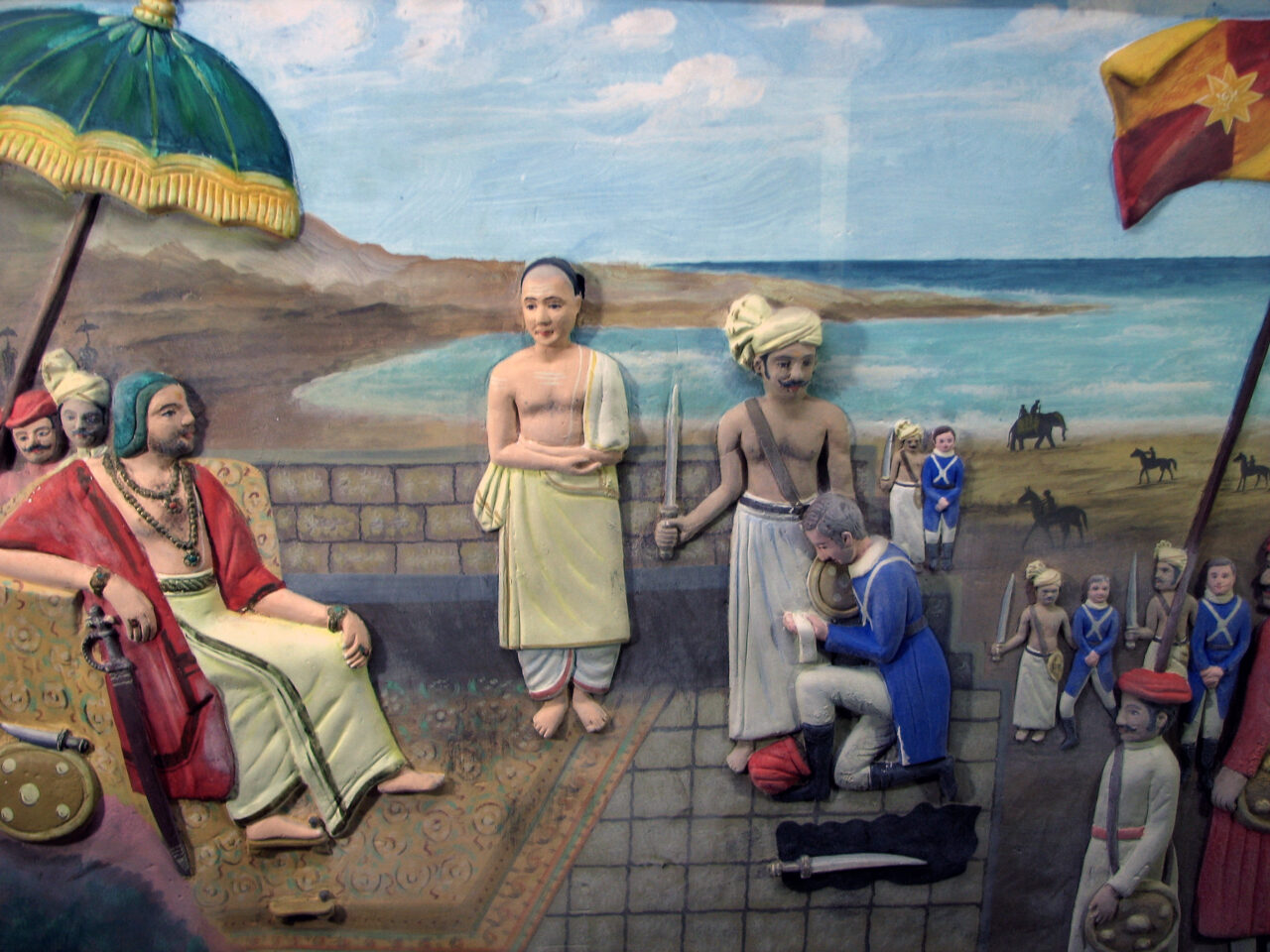
Southernmost part of our country, especially Kerala, was well integrated into the ancient trade network since the first millennium BCE. Traders from various parts of the world came to this part of the country in search of spices and other commodities. People also came through these trade routes to get away from religious persecution and settled in Kerala, for example, Jews and some sections of Christians. Most probably, in the Middle Ages, the Arabs became a significant factor in this trade network, owing to their geographical position and seafaring communities. Through Arab traders, Islam also reached the shores of Malabar and gained foothold in places like Calicut, Kodungalore etc.
The arrival of the Portuguese in India, in search of spices and with a religious mission, transformed the socio-cultural, economic and political dynamics of this region forever. At the time of the Portuguese arrival, Kerala was divided into various small kingdoms and principalities. Among these, Kolathiri of the north, Samorin of Calicut, Cochin in the middle and Travancore in the south were the main rulers. Though there were wars between these kingdoms and principalities with petty differences, conflicts in the name of religion were almost unknown. The arrival of the Portuguese and their conflict with Muslims marked the beginning of conflicts motivated by religion. This new ingredient of war not only altered the existing equilibrium in the region but also pushed it to slavery.
The Portuguese
The struggle against foreign powers on the western coast of India started soon after the arrival of the Portuguese on the shores of Calicut in 1498 CE. Vasco Da Gama was the leader of the Portuguese expedition. He came with two ships and he was on board a ship named St. Gabriele. The aim of the Portuguese expedition was not only commercial but also religious. On 8th January 1454 CE, Pope Nicholas V granted a papal bull to Affonso V, the king of Portugal, an exclusive right to all countries that might be discovered by his subjects between the west coast of Africa and the continent of India. Papal assent to conquering new lands for Christendom was the essence of this papal bull.
Before the arrival of the Portuguese, trade between India and Europe was predominantly in the hands of Arab-Muslims. Hence, when Portuguese came to the coast of Malabar, the Muslims considered it a threat to their monopoly. Therefore, they instigated Zamorin, the ruler of Calicut, against the Portuguese and asked him not to trade with them. This Muslim behavior and the doubts of Da Gama about Muslim designs soon culminated in conflicts. The delinquent behavior of the new commerce naturally forced the Zamorin to take action against the Portuguese.
Though there were intermittent intervals, the conflict between Zamorin and the Portuguese continued for almost 165 years, till the closure of the Portuguese era in Malabar. The irony is that we failed to recognize the sagacious role of Zamorins in the struggle against the Portuguese; instead, we celebrated one Kunjali among the four Kunjalis who fought against the Portuguese in the name of Zamorin. Further, we should not forget that the battles of Kunjali were motivated by religious fervor and monopolistic trade aspirations.
Like elsewhere, under Portuguese patronage, the religious policies adopted by Jesuits in Kerala were also of intolerance. The main problem with the conversion of Hindus was the question of sovereignty. The converted people considered themselves subjects of the Portuguese and refused to submit to the law of the land. Nevertheless, the revolt of a group of native Christians against the imposition of Latin tradition and the establishment of a new church named Malankara Church in 1653 CE is also an interesting episode of this era.
The Dutch
The dawn of Dutch ascendancy in Malabar began with their capture of the fort of Cochin from the Portuguese in 1663. In the initial days, the Zamorins of Calicut had tactical bonhomie with the Dutch, but later they fought against them to emphasize their sovereignty. The decline of Dutch power in India is marked from the conclusion of the Treaty of Mavelikkara in 1753 CE. Marthanda Varma, the king of Travancore, inflicted the first and decisive blow on Dutch power in Malabar, and the English inflicted the final blow.
The conflict between Travancore and the Dutch started when Marthanda Varma began the consolidation of his kingdom. The Dutch perceived it as a threat to their interests since they were benefiting from the fragile political situation in the region. Therefore, they started interfering in internal politics under the pretext of helping Kayamkulam and Elayidath Swaroopam. Marthanda Varma requested the Dutch East India Company to abstain from interfering in his kingdom’s internal affairs and asked them to concentrate on their mercantile interests alone. But the Company refused this advice and installed the Queen of Elayidath Swaroopam as sovereign.
Hence in 1741 CE, the Maharaja moved his forces against the combined force of the Queen and the Dutch. Travancore forces inflicted a crushing blow and the Queen and the Dutch fled to Cochin. Following this, a Dutch fleet from Sri Lanka landed in Colachel, the southern flank of Travancore. Here also the Travancore army under Marthanda Varma vanquished the enemy. This war at Colachel marked the end of Dutch supremacy in India.
There are a few interesting facts to be noted here. First, to understand the importance of Travancore’s victory over the Dutch, we should analyze it in the background of Dutch history in the Indian Ocean region. For example, across the coast in Sri Lanka, Dutch power lasted till 1796—nearly fifty-five years after the Colachel war. Second, the English at Anjengo factory were ready to support Marthanda Varma’s expedition, but he politely declined, conscious that foreign involvement in native affairs would harm sovereignty.
Marthanda Varma
Marthanda Varma is regarded as the builder of modern Travancore. He ascended the throne in 1729 CE. Immediately after ascension, he started consolidating power and expanding Travancore. As part of this, he annexed many petty principalities and vassalages. He was a statesman and never allowed foreigners to interfere in native affairs.
When he decided to move against Kayamkulam, Dutch Governor M.A. Maten sent a messenger asking him not to attack. The Maharaja replied that the Dutch East India Company should restrict itself to commerce and avoid political interference. The English of Anjengo factory also offered support but he declined.
In 1739 CE, when Travancore forces marched to Kayamkulam, Dutch Governor of Ceylon Van Imhoff met the Maharaja and threatened invasion. The Maharaja calmly responded that he could retreat to forests, to which Van Imhoff replied they could follow him. The Maharaja retorted that if the Dutch executed their threat, he would think of invading Europe with native boats.
In 1741 CE, Van Imhoff installed the Rani of Elayidath Swaroopam as sovereign. Travancore army marched, defeated the allied force, destroyed Dutch posts and factories and the Rani and Dutch fled to Cochin.
Meanwhile, a Dutch fleet from Ceylon landed at Colachel and plundered villages. The Maharaja marched with full force and Rama Iyen Dalawah was sent with reinforcements. Travancore arranged Munchees (native boats) and on 10th August commenced attack. The Maharaja led personally. Travancore army broke Dutch lines; the Dutch withdrew to Colachel fort. On 14th August the fort was besieged and captured. Dutch fled to Cochin. This war marked the end of Dutch supremacy in the Indian Ocean.
The English
The English arrived in Malabar in the year 1615 CE. Captain Keeling, with three ships, reached Kodungalore (Cranganore) and entered into a treaty with the Zamorin of Calicut. In their initial years, they established small factories at Ponnani and Calicut, but the Zamorins were not in favor of foreign settlements. Hence later, the English moved to other places and established factories at Travancore, Anjengo and Tellicherry between 1684–99. Like their predecessors, by 1721 CE, the English also started their active interference in native politics. But the initial reaction was fierce; a delegation led by the Company’s Anjengo Chief Gyfford was cut down.
In 1729, Marthanda Varma ascended the throne in Travancore. While consolidating his power, he fought against the Dutch, with tacit support from the English. In the following years, the English slowly consolidated their power in various parts of Southern India. In 1766 CE, Haidar Ali invaded Calicut and ravaged the kingdom of Zamorin, inaugurating an era of chaos in that part of Malabar. After Haidar, his son Tippu unleashed a reign of terror on the people of Malabar. Following the Treaty of Srirangapattanam (1792 CE) with Tippu, the English announced that the whole of Malabar was ceded to them. This arbitrary attitude sowed the seeds of future conflict in Malabar.
Pazhassi Raja
Kerala Varma Raja (Pazhassi), as he was known, became an embodiment of unrest among native people and their resistance against English rule. He was a natural leader and the legitimate king of Kottayam in North Malabar, belonging to the western branch of the Kottayam royal family. After the Srirangapattanam Treaty of 1792 CE, the English bypassed his authority in favor of his uncle. Not only did this hurt the self-esteem of Pazhassi, but it also rekindled his quest for freedom, since he was not ready to compromise on his sovereignty. In fact, that was the reason why he continued his fight during 1787 to 1790 against Tippu, even after withdrawing to the woods.
Therefore, when Pazhassi drew his sword against the English, he already had this experience. Using his influence in the kingdom, he organized resistance. With the support of local people, from the depths of the Western Ghats, he also organized skirmishes and perplexed the English. They lost many men in these engagements; in one engagement in 1797 CE alone, they lost more than 1000 people. After this incident, the Commander-in-Chief of the English army visited Malabar and arranged for a treaty with Pazhassi. Following this, there was a brief period of peace.
Two years later, after the fall of Tippu, when the English challenged his sovereignty, Pazhassi revolted again. In 1800 CE, the English even brought Colonel Arthur Wellesley, later the Duke of Wellington (who defeated Napoleon), to subdue Pazhassi, but he too failed in front of him. Nevertheless, ultimately they succeeded in eliminating him in 1805 CE, that too by means of treachery. In his letter to the Malabar Collector, Baber, the Sub-Collector of Malabar who led the team that killed Pazhassi, mentions him as the natural chief of the country and a wonderful persona.
The role played by hill tribes like Kurichiyars and Kurumbars in the resistance of Pazhassi Raja is a vibrant part of our freedom struggle.
Velayudhan Chempakaraman Pillai (Velu Thampy Dalawa)
Velu Thamby rose to prominence when he opposed the tyranny of Jayanthan Sankaran Nampoodiri, the Prime Minister (Dewan) of Travancore. Nampoodiri became Prime Minister after the mysterious death of Dewan Raja Kesavadas, an able administrator. The new Prime Minister unleashed a reign of terror and started literal extortion in collusion with others like Mathu Tharakan, a Syrian Christian. As part of this extortion, Nampoodiri summoned Velu Thamby, an ex-Tahasildar, and demanded immediate payment of around 3000 rupees.
He even threatened Thamby with punishment if he did not comply. Thamby, a bold young man with good intelligence belonging to a respectable family, told Nampoodiri that he had no money at the moment and would return to Nanjenadu and arrange the amount in three days. Nampoodiri accepted the proposal but made Thamby sign a promissory note before allowing him to leave.
Immediately after reaching home, Velu Thamby organized a council to discuss the extortion and tyranny. People from across Travancore gathered and decided to revolt against the oppressors. On receiving intelligence about the mobilization, Nampoodiri ordered his apprehension. This prompted Thamby and others to march to Trivandrum Fort. When they reached, people from the north were already present. Out of respect for the Maharaja, they did not force their entry. A perplexed Maharaja sent representatives to meet them.
As leader, Velu Thamby presented three demands—dismissal and banishment of Jayanthan Nampoodiri, punishment of Sankara Narayanan and Mathu Tharakan, and concession in taxes. The Maharaja accepted the demands. Nampoodiri and his accomplices were handed over and punished through summary trial.
Velu Thamby and Chempaka Raman Pillai later met the Maharaja. After the meeting, Chempaka Raman Pillai became Prime Minister and Velu Thamby was appointed Commerce Minister. In 1801, after Chempaka Raman Pillai’s demise, Velu Thamby became Prime Minister. He was bold, talented, honest and aimed at public welfare. He brought order and almost eradicated corruption, known for strict punishments to deter delinquency.
Initially, Velu Thamby maintained cordial relations with the English Resident, Colonel Colin Macaulay. But when Macaulay began interfering in administration and imposed financial burdens, relations strained. He even attempted to remove Velu Thamby, widening the rift. Meanwhile, Paliath Achan of Cochin also grew hostile toward Macaulay. Both Dewans united to act against the English.
On 11 January 1809 CE, Velu Thamby issued the Kundara Proclamation, exposing English motives and urging resistance. Revolts broke out across Travancore, including Quilon. However, British forces suppressed the uprising. Velu Thamby fled to the forests and later reached Mannady. The British announced a reward for his capture. The new Dalawah colluded with the English.
Velu Thamby and his brother took refuge in Mannady Bhagavathi Temple. To avoid disgrace, Velu Thamby chose death. He asked his brother to stab him, but when he hesitated, Velu Thamby pierced his own chest and asked him to sever his head. He complied, and Thamby died a martyr. British soldiers reached only to find both dead. Their bodies were taken to Trivandrum and displayed insultingly.
Paliath Achan
Paliath Achans were the hereditary Chief Ministers of Cochin. After the demise of the then Paliath Achan in 1779 CE, Shaktan Tampuran, the king of Cochin, abolished the hereditary Chief Ministership, as the senior Achan at that time was a minor. When he grew up, he tried to regain the position but failed. However, after the demise of Shaktan Tampuran, his cousin ascended the throne. Velu Thamby, the Dalawah of Travancore, used his influence to appoint Achan as Chief Minister of Cochin.
Achan was capable, and Velu Thamby was his role model. During this time, the insolent behavior of the English increased, particularly that of Resident C. Macaulay. Achan and Velu Thamby discussed plans to expel the English and even contacted the Zamorin and the French for support. Achan urged the Cochin Raja to join hands with Travancore and the French to expel the English. But the Raja opposed open confrontation.
Despite this, the confederates recruited and trained men. Achan raised 3000–4000 men. Due to disagreement, the Raja was shifted to Vellarapilli and placed under supervision. Around this time, Resident Macaulay sheltered Kunji Krishna Menon, a Cochin subject. Achan demanded his handover, but Macaulay refused — triggering immediate conflict.
On 28 December 1808 CE, around 600 men led by Achan and two officers under Velu Thamby surrounded the Residency to capture Macaulay. They overpowered English soldiers and plundered the building, but Macaulay and Menon escaped to an English ship with Portuguese help.
On 19 January 1809 CE, Achan led a 3000-strong force to attack Cochin but failed with no major breakthrough. Two days later, they attacked the Dutch Governor’s house and destroyed it. On 25 January, another assault was launched, still with no major gain. Meanwhile, the British mobilized large reinforcements.
Seeing the revolt weakening, the English offered terms ensuring Achan’s life but forbidden from residing in Cochin. Achan accepted and surrendered on 27 February 1809 CE. With his surrender, the uprising collapsed in Cochin. Achan was first confined in Madras, later shifted north; he was never allowed to return to Cochin. He died in Varanasi.
Vaikom Padmanabha Pillai
Vaikom Padmanabha Pillai was a close confidant and trusted friend of Velu Thamby Dalawa. He was also the General of Travancore’s army. He is celebrated for his bravery in battles against Mysore under Tipu Sultan.
At the beginning of the revolt against the English, under his leadership, Travancore forces secretly reached Cochin and joined Paliath Achan. They attacked Resident Macaulay’s house and the English forces on 28 December 1808. Later, he ambushed a British troop near Alleppey and wiped them out.
In 1809, the British captured him, and he was executed for his role in the uprising.
Chembil Arayan (Anantha Padmanabhan Valiya Arayan)
Chembil Arayan served as the Admiral of the Travancore fleet. During the 1808 revolt, he commanded the naval squad that joined Paliath Achan and Padmanabha Pillai in attacking Macaulay’s Residency. His fleet consisted of small boats, covered for camouflage, enabling secret arrival at Cochin.
Kurichiya Revolt
The Kurichiyas are a tribal community belonging to the Western Ghats region of Kerala, also known as Malai Brahmins. They were skilled archers and played a crucial role in Pazhassi Raja’s resistance against the British.
After Pazhassi Raja’s death in 1805 CE, the British unleashed severe oppression. They exploited, plundered and harassed the tribes. Tax was imposed in cash, which was impossible since they followed a barter economy. Harassment grew unbearable, leading to a major revolt in April 1812 CE by the Kurichiyas and Kurumbas.
They adopted guerrilla warfare, attacked garrisons and offices, and blocked routes. Soon, many revenue officials and local police joined them — turning it into a mass uprising. Eventually, the English East India Company brought reinforcements from Mysore and suppressed the revolt. Many rebels were arrested; lands were confiscated; several were enslaved.
A. Sankara Iyer (Sankaraiah)
A. Sankara Iyer, known as Sankaraiah, was the Dewan of Cochin. A Tamil Brahmin educated at Presidency College, Madras, he worked as a lecturer and legal practitioner before joining Cochin administration.
In 1880, he founded Hindu Sabha in Cochin to promote social and religious reforms among Hindus — aiming to eliminate dogmas and promote unity. The Sabha published a journal Hindu Reformer and Politician. Sankaraiah was a close associate of Madame Blavatsky and Colonel Olcott of the Theosophical Society.
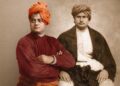
In 1892, when Sankaraiah was Acting Dewan, Swami Vivekananda visited him with a letter from Sheshadri Iyer, the Dewan of Mysore, and stayed as his guest. Sankaraiah adopted unique and courageous modes of protest against colonial rule — now overlooked chapters in Kerala’s history.
Neelakanta Brahmachari
Neelakantan (Neelakanta Brahmachari) was a revolutionary linked with V.V.S. Iyer and the secret Bharat Mata Association. In June 1910, Neelakantan and his aide Sankaranarayanan toured Cochin, Alapuzha, Punalur and Sengottai delivering speeches on Swadeshi and boycott and exposing colonial injustices.
Harihara Iyer, inspired by him at Alapuzha, later financially supported the revolutionary cause. He wrote to Vanchi Iyer calling Neelakantan “the firstborn son of Bharat Mata”. Members of the Bharat Mata Association later assassinated Collector Ashe at Tirunelveli.
Vanchinathan
Vanchi Iyer, known as Vanchinathan, met Neelakanta Brahmachari after the formation of Bharat Mata Association. He worked in Punalur Forest Office at that time and soon became an active revolutionary.
When the Association decided to eliminate Collector Ashe, Vanchinathan took responsibility. On 17 June 1911, at Maniyachi Railway Station, he entered Collector Ashe’s coach and shot him. The bullet pierced Ashe’s chest; he collapsed and died shortly after. Vanchinathan then went to the train lavatory and shot himself.
In British records, the event is documented as the Tirunelveli Conspiracy Case. After Independence, the station was renamed Vanchi Maniyachi Railway Station in his honour.



Discussion about this post