

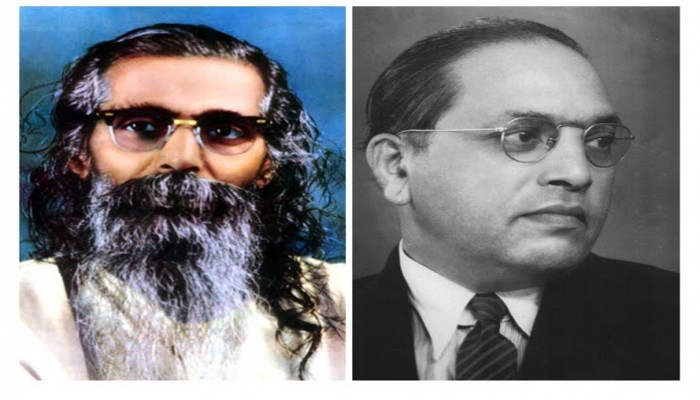
There has probably never been another statesman in modern India who contributed to the social sciences as profoundly as Dr. Babasaheb Ambedkar. His intellectual wealth stretches across twenty-three volumes. The only body of writing that rivals it in sheer scale is the Collected Works of Mahatma Gandhi, which runs to about a hundred volumes. Babasaheb Ambedkar, an intellectual giant, thinker, writer, and above all the architect of the Indian Constitution, needs no introduction. His magnum opus is Pakistan or the Partition of India, written at the end of 1940. This book, one of the most relevant of Ambedkar’s works and still read by thousands even today, stands as clear evidence of his unwavering intellectual honesty and extraordinary foresight. Throughout his life, he never gave the slightest value to political correctness. Anyone reading Pakistan will understand that.
Yet, many harsh expressions, criticisms, and even certain passages in which he attacked the regressive tendencies of Islam had to be removed at the time of publication, as revealed by Shri Dhananjay Keer, the author of his most authoritative biography. Dhananjay Keer summarized the enormous work Pakistan or the Partition of India in three paragraphs in his book Dr. Babasaheb Ambedkar: Life and Mission.
Left fraudsters portray Guruji Golwalkar as anti-Muslim and communal solely because of a single subtitle in Bunch of Thoughts titled “Muslim Problem.” That subtitle, however, was provided by the compiler of the volume. This is the only weapon the Left-Islamist nexus uses against Guruji. Has any one of them ever quoted even a single line from the Bunch of Thoughts to support their accusations? The answer is no. Because, in reality, there is nothing in it that would hurt the feelings of an ordinary Muslim believer. Neither Muhammad, nor Allah, nor the Quran is a subject of criticism in the Bunch of Thoughts. Guruji speaks only of the political ideology of Islam, political Islam, which he views as a doctrine of terror.
But in Thoughts on Pakistan, Dr. Ambedkar’s criticism and attack is directed squarely at Islam as a religion, its foundational principles, and the average Muslim believer. His views on Islam did not change until the day he died. He even had to remove many sentences and entire passages from the book because his close friends were concerned that his life might be in danger. At the end of this article, the significant portions of criticism that still remain after that “deadly” editing, are quoted.
Ambedkar was one of the few political leaders who strongly argued for a population transfer. He wanted to send all the Muslims to Pakistan and bring back all Hindus, who belong to all castes including Dalits, to India. He shares his logic behind this stance, in the Pakistan or Partition of India: “…it is better to have Muslims whose loyalty to India is always doubtful, without and against, rather than within and against. A safe army rid of the Muslim preponderance is better than a safe border.” That is, he lays bare the social reality of the period in extremely strong language that Muslims who lack loyalty to the nation are an “internal threat”; that it is better to ‘keep the enemy outside the country than within it.’
Here is what Ambedkar writes about the average Muslim: “The spirit of aggression is a Muslim’s natural endowment. He takes advantage of the weakness of the Hindu, which ultimately results in gangsterism.” While Ambedkar supported partition and Savarkar opposed it, the concerns of both were identical. The only difference is that Ambedkar articulated them in sharper language. While Hindutva asserts that a Muslim can remain a patriot and nationalist while following his religion, Dr. Ambedkar argues that a person born a Muslim can never regard India as his motherland.
When personal interest and national interest diverge, it is the fundamental duty of a citizen to place the nation above oneself. As he said: “I know my position has not been understood properly in the country. I say that whenever there has been a conflict between my personal interests and the interests of the country as a whole, I have always placed the claims of the country above my personal claims. I have never pursued the path of private gain… so far as the demands of the country are concerned, I have never lagged behind.”
To define national consciousness, Dr. Ambedkar uses two words in Pakistan or Partition of India: kinship and desire. He defines nationalism as “consciousness of kind, awareness of the existence of that tie of kinship.” He describes national aspiration as “the desire for a separate national existence for those who are bound by this tie of kinship.”
The very elements lacking in communists and Islamists are precisely these two, this kinship and desire, the natural feeling of unity and identification with one’s nation and people. Guruji classified as “internal threats” those groups who lack this feeling. Those who possess this feeling are called “Hindus,” regardless of their religious customs.
A small challenge to fake Ambedkarites: can you point out even one sentence from Guruji’s Bunch of Thoughts or Savarkar’s Hindutva that is sharper or more “Islamophobic” (in your terms), or even comparable, to Ambedkar’s critiques of Islam and Muslims?
(If you read Dr. Ambedkar’s little book Christianity in India and his extensive anti-Communist writings spread across various books and Constituent Assembly debates, you will better understand what Venkata Rao, the editor of The Bunch of Thoughts, meant by “Internal Threats.”)
‘Problems of Muslim Attitude’- Dr Ambedkar
In the book, Dr. Ambedkar identifies four major issues, collectively calling them the “Problems of Muslim Attitude.” These include: the exploitation of Hindu weakness by Muslims, disputes over music before mosques and cow slaughter, Muslim opposition to Hindu rule, and gangsterism in politics. Here is how he explains each point:
Exploitation of Hindu weakness by Muslims:
(A) thing that is noticeable among the Muslims is the spirit of exploiting the weaknesses of the Hindus. If the Hindus object to anything, the Muslim policy seems to be to insist upon it and give it up only when the Hindus show themselves ready to offer a price for it by giving the Muslims some other concessions. (P268)
Music in front of Mosque and Cow Slaughter:
Another illustration of this spirit of exploitation is furnished by the Muslim insistence upon cow-slaughter and the stoppage of music before mosques. Islamic law does not insist upon the slaughter of the cow for sacrificial purposes and no Musalman, when he goes to Haj, sacrifices the cow in Mecca or Medina. But in India they will not be content with the sacrifice of any other animal.
Music may be played before a mosque in all Muslim countries without any objection. Even in Afghanistan, which is not a secularized country, no objection is taken to music before a mosque. But in India the Musalmans must insist upon its stoppage for no other reason except that the Hindus claim a right to it. (P269)
Muslim Opposition to Hindu Rule:
Willingness to render obedience to the authority of the government is as essential for the stability of the government as the unity of political parties on the fundamentals of the state. It is impossible for any sane person to question the importance of obedience in the maintenance of the state. To believe in civil disobedience is to believe in anarchy.
How far will Muslims obey the authority of a government manned and controlled by the Hindus ? The answer to this question need not call for much inquiry. To the Muslims a Hindu is a Kaffir.* A Kaffir is not worthy of respect. He is low-born and without status. That is why a country which is ruled by a Kaffir is Dar-ul-Harb to a Musalman. Given this, no further evidence seems to be necessary to prove that the Muslims will not obey a Hindu government. The basic feelings of deference and sympathy, which predispose persons to obey the authority of government, do not simply exist. But if proof is wanted, there is no dearth of it. It is so abundant that the problem is what to tender and what to omit. (p300-301)
Gangesterism in Politics:
(Another) thing that is noticeable is the adoption by the Muslims of the gangster’s method in politics. The riots are a sufficient indication that gangsterism has become a settled part of their strategy in politics. They seem to be consciously and deliberately imitating the Sudeten Germans in the means employed by them against the Czechs.
So long as the Muslims were the aggressors, the Hindus were passive, and in the conflict they suffered more than the Muslims did. But this is no longer true. The Hindus have learned to retaliate and no longer feel any compunction in knifing a Musalman. This spirit of retaliation bids fair to produce the ugly spectacle of gangsterism against gangsterism. (p269)
Ambedkar’s close call with a ‘Sar Tan Se Juda’ moment
Dhananjay Keer’s famous biography titled ‘Dr. Babasaheb Ambedkar: Life and Mission’, the one and only authentic biography read and approved by Dr. Ambedkar, offers a glimpse into the churning process he underwent while writing the book.
“This historic book castigates the anti-reformist tendency of the Muslims. It observes that the dominating influence with the Muslims is not democracy. The predominant interest of Muslims is religion, their politics being essentially clerical. The Muslims are opposed to social reform, and are an unprogressive people all over the world.
To the Muslims, the book states, Islam is a world religion, suitable for all peoples for all times and for all conditions. The brotherhood of Islam is not the universal brotherhood of man. It is the brotherhood of Muslims for Muslims only. For non-Muslims, there is nothing but contempt and enmity. The Muslim has allegiance to a nation which is ruled by a Muslim; a land not ruled by a Muslim is his enemy land. The book, therefore, concludes that Islam can never allow a true Muslim to adopt India as his Motherland and regard a Hindu as his kith and kin. The spirit of aggression is a Muslim’s natural endowment. He takes advantage of the weakness of the Hindus and follows gangsterism,” Keer provided a summary of the book.
Dr Ambedkar minced no words in stating his opinions about the teachings of Mohammad, the founder of Islam, and the regressive and undemocratic nature of Islam. In the book, he has openly criticised Muslim fanaticism and exposed Islam’s crimes against India and the persecution of Hindus under Islamic rule.
For instance, Dr Ambedkar has quoted Kazi’s reply to Sultan Alauddin to describe the plight of the Hindus under barbaric Islamic rule: ‘They (Hindus) are the most inveterate enemies of the Prophet, and because the Prophet has commanded us to slay them, plunder them, and make them captive, saying, ‘Convert them to Islam or kill them, and make them slaves, and spoil their wealth and property’!
“These ideas were well expressed by the Kazi in reply to a question put by Sultan Ala-ud-Din wanting to know the legal position of the Hindus under Muslim law. The Kazi said :— “They are called payers of tribute, and when the revenue officer demands silver from them they should without question, and with all humility and respect, tender gold. If the officer throws dirt in their mouths, they must without reluctance open their mouths wide to receive it…..The due subordination of the Dhimmi is exhibited in this humble payment, and by this throwing of dirt into their mouths. The glorification of Islam is a duty, and contempt for religion is vain. God holds them in contempt, for he says, ‘Keep them in subjection’. To keep the Hindus in abasement is especially a religious duty, because they are the most inveterate enemies of the Prophet, and because the Prophet has commanded us to slay them, plunder them, and make them captive, saying, ‘ Convert them to Islam or kill them, and make them slaves, and spoil their wealth and property’. No doctor but the great doctor (Hanifah), to whose school we belong, has assented to the imposition of jizya on Hindus; doctors of other schools allow no other alternative but ‘Death or Islam’.”
Such is the story of this period of 762 years which elapsed between the advent of Muhammad of Ghazni and the return of Ahmadshah Abdalli,” quoted Ambedkar in his book.
Further, Dhananjay Keer revealed that some ‘penetrating and caustic paragraphs’ were deleted from the book at the request of Ambedkar’s close admirers. This means, the presently available volume of ‘Pakistan or Partition of India’ was subject to censorship which was imposed out of pressure from his well-wishers! According to Keer, if the book was not censored, Ambedkar would have experienced what H. G. Wells experienced at the hands of Muslims in London!
“Some penetrating and caustic paragraphs describing the regressive bent of the Muslim mind, however, were deleted, it is said, at the instance of Ambedkar’s close admirers. Otherwise the author of Thoughts on Pakistan would have experienced what H. G. Wells experienced at the hands of Muslims in London,” writes the biographer.
What did H G Wells experience at the hands of Muslims in London? Long story short, a group of South Asian working class Muslims, mostly Indians, took to the streets of London to protest against a book written by H G Wells, that allegedly contained ‘insulting remarks’ about Muhammed, the founder of Islam! The incident took place in August, 1938. According to the Guardian of 13 August 1938, they ‘ceremoniously committed to the flames’ a copy of H. G. Wells’s A Short History of the World because of references to the Prophet Muhammad which they considered offensive. In ‘A Short History of the World’, first published in 1922, a chapter entitled ‘Muhammad and Islam’, offers a glimpse into the life and teachings of Muhammad. Wells introduced Muhammad as a man of ‘very considerable vanity, greed, cunning, self-deception and quite sincere religious passion’. For wells, Quran was ‘unworthy of its alleged Divine authorship’. Interestingly, it was Indian Muslims who cried foul over alleged blasphemy in the book, baying for the blood of H G Wells.
Guruji or Ambedkar?
The fake Ambedkarites who never want to discuss Ambedkar’s book on Pakistan, must read Guruji Golwalkar’s Internal Threats: On Muslims in Bunch of Thoughts alongside Babasaheb’s Pakistan or Partition of India. Here is Ambedkar’s conclusion from his book: “Islam can never allow a true Muslim to adopt India as his motherland and regard a Hindu as his kith and kin. That is probably the reason why Maulana Mahomed Ali, a great Indian but a true Muslim, preferred to be buried in Jerusalem rather than in India.” (pp. 330-331)
Dr. Ambedkar had already warned long ago about the danger behind the pseudo–Dalit-love displayed by Maududi-Jihadi groups. “I would like to tell the Scheduled Castes who happen to be impounded inside Pakistan to come over to India by such means as may be available to them. The second thing I want to say is that it would be fatal for the Scheduled Castes, whether in Pakistan or in Hyderabad, to put their faith in Muslims or Muslim League. It has become a habit with the Scheduled Castes to look upon the Muslims as their friends simply because they dislike Hindus. This is a mistaken view.”
(The Free Press Journal, November 28, 1947. Cited in Dr Ambedkar: Life and Mission, Dhananjay Keer, p. 399).
American historian Eric Louis Beverly informs us in his book Hyderabad, British India, and the World (Cambridge University Press, 2015) that the Nizam of Hyderabad offered Dr Ambedkar Rs. 75 million if he and his flock converted to Islam. Babasaheb spurned the offers of Christians and Muslims. He said, “If one converts to Christianity he ceases to be an Indian. The brotherhood in Islam is confined to the Believers; that is, only to Muslims. It cannot promote universal brother-hood. I will not convert to either of these religions.”
Dr Ambedkar saw conversion to Islam and to Christianity as a factor contributing to the “denationalisation” of Dalits and Bharat. Compared to Ambedkar’s words, the criticisms made by Guruji and other Hindutva thinkers appear insignificant. (Another Ambedkar biography worth reading alongside is the one which was written by Dattopanth Thengadi. Thengadi, an RSS pracharak and social thinker, had a close personal relationship with Ambedkar. In the election where Congress and Communists united to defeat Ambedkar, Thengadi stood firmly beside him and served as the convener of his campaign.)





Discussion about this post