

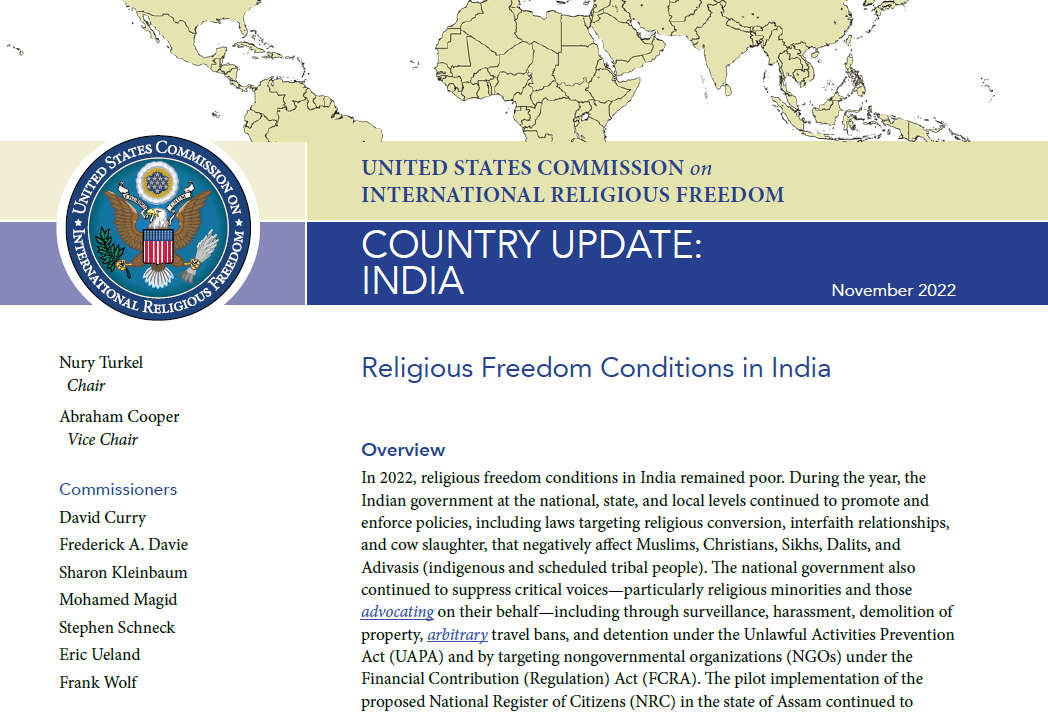
New Delhi: A group of prominent Indian signatories, including former diplomats and senior administrators, has issued a strongly worded response to a recent report by the United States Commission on International Religious Freedom (USCIRF), alleging that it presents a “disturbing and completely off-the-mark” assessment of religious freedom in India. The statement calls for a more data-driven and historically grounded evaluation, arguing that the USCIRF report relies on “selective or episodic narratives” rather than long-term demographic evidence.
“Need for Longitudinal Evidence, Not Selective Narratives”
At the heart of the criticism is the claim that global assessments of religious freedom must go beyond isolated incidents. The signatories emphasized:
“The way to assess the credibility and balance of reports… need[s] to examine long-term demographic trends… providing a more objective and longitudinal measure of religious freedom.”
They argue that such an approach offers a more reliable indicator of systemic conditions than reports based on short-term observations.
Partition Context and Regional Comparison
The statement places its argument within the historical context of the Partition of India, noting that religious demographics across the subcontinent have evolved significantly since 1947.
According to the signatories:
Hindus constituted approximately 20.5% of the population in undivided Pakistan (including present-day Bangladesh) at Partition
Today, Hindus form 1.5–2% in Pakistan and 7–8% in Bangladesh.
They describe this as:
“A significant decline… from around 20–22% in 1951… to their bare presence in the present scenario.”
The statement adds that this trend is “widely acknowledged in academic and policy discourse,” and raises concerns about the long-term trajectory of minority communities in the region.
India’s “Contrasting Demographic Stability”
In contrast, the report highlights India’s demographic trends as evidence of what it calls a more stable and inclusive environment for minorities.
Citing official census data, the signatories note:
Muslims: 9.8% (1951) → 14.2% (2011)
Christians: ~2.3% (1951) → ~2.3% (2011)
Sikhs: ~1.79% (1951) → ~1.72% (2011)
They argue:
“Such longitudinal evidence… suggests that the overall ecosystem in India has not produced the kind of sustained demographic contraction… that would ordinarily indicate systemic persecution.”
Criticism of USCIRF’s Portrayal of Indian Institutions
The statement also raises concerns about what it calls a recurring bias in USCIRF reports toward Indian institutions and organizations, including the Rashtriya Swayamsevak Sangh (RSS).
It states:
“The recurring tendency of USCIRF to portray Indian state institutions and socio-cultural organizations… in overwhelmingly negative aspects… raises legitimate concerns about analytical balance.”
While acknowledging that critique is necessary in a democratic system, the signatories stress:
“Such critique must be grounded in verifiable evidence and contextual understanding, not broad generalizations.”
India’s Democratic Safeguards Emphasized
The signatories underline India’s democratic and institutional framework as a key safeguard for religious freedom, describing the country as:
“The largest democracy of the world,”
with a “robust, time-tested judicial system” and “vibrant democratic institutions and parliamentary oversight.”
They assert that:
“There’s very less scope for individuals or organizations to go scot-free after violating someone’s religious rights.”
Strong Objection to USCIRF Recommendations
The statement sharply criticizes reported USCIRF recommendations such as sanctions or restrictions, calling them:
“Highly motivated… displaying intellectual bankruptcy and deranged conclusions.”
It also questions the composition of the commission, noting that its members are appointed by the Government of the United States and funded by U.S. taxpayers.
The signatories demand:
“A strict background check of all the contributors to this report… [which] will be an eye opener to the taxpayers of the US.”
The statement also exposed the unfair criticism of the RSS. The statement described RSS as an organization with a long-standing role in nation-building since its founding in 1925.
It highlights:
“Selfless service in areas of rural empowerment, women’s progress, healthcare and education through thousands of projects.”
Additionally, it notes that RSS-inspired organizations globally have contributed to disaster relief and social welfare initiatives.
Call for Fairness in Global Discourse
Concluding the statement, the signatories emphasize that religious freedom must be evaluated with fairness and intellectual rigor: “Religious freedom… must be exercised with intellectual rigor, fairness, and respect for all.” They warn that: “Reports based on selective use of evidence are subject to reduce their own credibility.”






Discussion about this post