
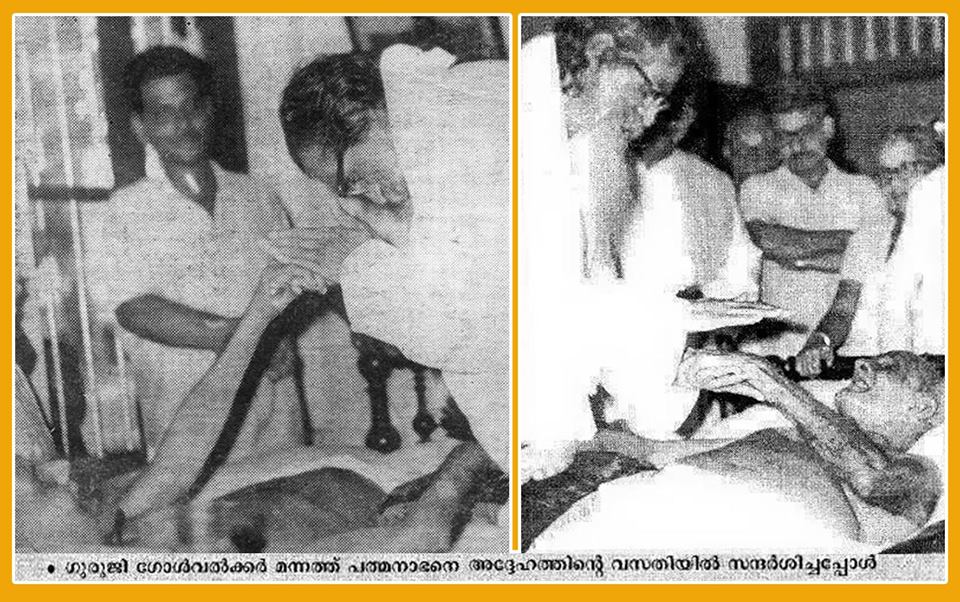
“Every village in Kerala must proudly maintain at least one RSS Shakha, because this is the only true national organisation with roots all over the country. If I had been a little younger, I would have actively participated in the physical activities of the RSS”: said Sri Mannathu Padmanabhan, in the speech he delivered at the grand meeting organised at the Sri Chitra Hindu Religious Library Hall in Thiruvananthapuram as part of the celebrations of Sri Guruji’s 51st birthday.
Among the organisations that led the social reform movements in Kerala, the Nair Service Society holds a unique position. The efforts of the NSS to eradicate caste discrimination, internal stratification, and regressive customs that were prevalent in the Hindu community constitute one of the most important chapters in modern Kerala history. Alongside Shri Narayana Gurudevan and Mahatma Ayyankali, Bharatakesari Sri Mannathu Padmanabhan was a great social reformer who gave direction to the magnificent Hindu renaissance of Kerala.
There is hardly any need to enlighten Malayalis about the legacy of Sri Mannathu Padmanabhan and the historical contributions of the NSS. However, the attempts of some political leaders in Kerala to reduce the NSS into merely a local caste organisation must be thwarted. Was the NSS just another caste outfit which lacked a national outlook or Hindutva consciousness, and which kept away organisations like the RSS with prejudice? It is the Congress—whose leaders hesitate even to address Sri Mannathu Padmanabhan with the honorific title “Bharatakesari”—that leads such malicious propaganda.
Long before the RSS made its presence clearly felt in Kerala, the NSS already maintained connections with Hindu nationalist organisations. Drawing inspiration from Hindu national movements such as Arya Samaj and Hindu Mahasabha, Mannam proceeded with a broad Hindu outlook in all his activities within the NSS. During the 1920–1930 period, when encroachments by people of other religions upon Hindu private lands and destructions of temples were common, he led countless movements transcending caste and sectarian divisions. Mannam’s diaries and autobiography contain numerous references to such actions. Even while continuing as the leader of the NSS, he intervened in numerous Hindu issues. Moreover, he formed several small Hindu Sabhas and Hindu Mission units at the local level. (That is the subject of another article.)
If we condense Mannam’s broad Hindu consciousness into his own words, it would be as follows:
“I believe that the eternal Hindu Dharma does not accept caste or caste-based hierarchy, and that all the degeneration of Hindu society is due to caste differences. I believe that as a Hindu, the re-establishment of the sacred Hindu Dharma and the creation of a Hindu nation is my foremost duty. I solemnly resolve that at no point in my life will I act with caste considerations, and that I will devote all my abilities to the effort for the annihilation of caste.”
Even before the Rashtriya Swayamsevak Sangh began its work in Travancore, Mannam invited Veer Savarkar, revered as the originator of the Hindutva philosophy, to Changanassery. Veer Savarkar was the chief guest at the NSS Silver Jubilee celebrations in 1940. He presided over the Hindu Conference organised as part of the Jubilee celebrations.
Mannam recorded this historic event in his diary as follows:
“On 2 May 1940, the Jubilee inauguration took place in the afternoon.
From the morning onwards the Jubilee festivities began. The flag hoisting, Jubilee parole inauguration, exhibition inauguration, etc. took place smoothly. The reception to the President of the Nair Mahasammelanam, the procession, and related programmes were conducted in great splendour. It rained when the procession concluded.
On the 3rd, the conference continued.
On the 4th, the conference continued smoothly. The President of the Hindu Mahasabha was received from Chengotta. Many receptions were arranged along the way. The welcoming committee received Savarkar with great splendour and brought him in a procession. The Municipality presented a congratulatory scroll.”
According to late P. Parameswarji, Mannam established direct contact with the RSS during the formation of the Hindu Maha Mandal. The incident of communal forces setting fire to and destroying the Sabarimala temple accelerated his efforts toward Hindu unity. In his diary entry dated 14 January 1951, Mannam notes that he, along with the SNDP leader R. Shankar, went to the Government Residency in Thiruvananthapuram and met Dr. Shyama Prasad Mukherjee for an hour of discussion.
Parameswarji, who volunteered as an RSS Swayamsevak at the Hindu Mahasammelanam held in Kollam under Mannam’s leadership, recalls the event as follows:
“The Hindu Representatives Conference held at Changanassery on 23 January 1950 took an important decision. It gave the green signal for forming a Hindu Mandal without caste distinctions. As a continuation of this, the grand Hindu Mahasammelanam held from 12 to 18 May 1950 in Kollam was a landmark in history. Incidentally, I must say that I, the author of this article, who was then the RSS Pracharak in Kollam, along with hundreds of swayamsevaks, served as volunteers in that conference. The sight of Mannam and Shankar working hand in hand like Rama and Lakshmana remains unforgettable in my mind.”
A meeting Mannam had with Guruji in 1952 is noteworthy, as recorded in his diaries:
“On 14 November 1952, at 8 p.m., reached Kollam. Received the RSS Sarsanghachalak Golwalkar at the Hindu Maha Mandal office at 7 p.m. We stayed at the Mandal office.”
(Mannam’s Diaries, p. 925)
Later, in 1956, Mannathu Padmanabhan participated in the reception given to Guruji Golwalkar in Thiruvananthapuram as part of Guruji’s 51st birthday celebrations. The speech he delivered that day reflected the affection he had for the organisation called the RSS. Mannam openly stated in Guruji’s presence that if he had been younger, he would have taken part in the RSS Shakha.
The significant portions of that speech were published in the Organiser weekly, April 9, 1956. Its translation is given below:
“RSS is the only effective cure for the lack of strength and organisation and the consequent cowardice and wretched state of our Hindu race. Every village of Kerala must proudly possess a Shakha of the RSS which is the only true countrywide national organisation. Had I been younger, I would have gladly participated even in the physical activities of the RSS,” declared Sri Mannathu Padmanabhan, the 79 year old veteran Hindu leader of Travancore and the founder of the Nair Service Society, addressing a mammoth gathering in the Sri Chitra Hindu Religious Library Hall on the occasion of Sri Guruji’s 51th birthday celebrations in the capital of Kerala.
He continued: “We find the upsurge of Bharathiyatha in the work of the young Sangh workers. Though we are clever in delivering speeches after speeches, we have to admit that we sorrowfully lack in action. But we are very glad to note that the RSS goes the other way, believing and stressing more in action rather than in speeches. Let us all pray wholeheartedly for long life to Sri Guruji who should guide this worthy organisation to its cherished goal of Hindu renaissance.” (English report of the speech: Organiser Weekly, April 9, 1956)
After this conference, history tells us that the relationship between Guruji and Mannam grew even deeper. Later, in 1958, Mannam participated in an RSS meeting along with Guruji Golwalkar. It was at the invitation of late P. Parameswarji that Mannam agreed to preside over the meeting. Mannam recorded this information in his diary:
“On 30 September 1958, RSS worker Parameswaran came to Thiruvananthapuram. He said I must preside over Golwalkar’s meeting in Ernakulam. He asked whether I would agree to visit the NSS institutions when he arrives.”
“On 13 October, the reception meeting for Golwalkar. I was the president. Reached Ernakulam by flight from Thiruvananthapuram before two o’clock. From there I was taken by car to Prabhu’s house. Reached T.D. Hall with Guruji. Participated in the function there. At 5 p.m. presided over the public meeting of the RSS. Both Guruji and I addressed the gathering. It concluded at 8 p.m. Stayed with Guruji.”
When the invitation came from Guruji to participate in the birth centenary celebrations of Swami Vivekananda, Mannam grew closer to the Sangh during this period. Parameswarji, who witnessed the strengthening NSS–RSS friendship, wrote as follows:
“The Ernakulam programme and the direct personal contact and conversation between Sri Guruji and Mannam established a firm foundation for the affectionate relationship between the two. It continued uninterrupted. The Hindus both inside and outside Kerala greatly increased their trust in the organisational ability and leadership of Mannathu Padmanabhan. A special event paved the way for that. As part of Swami Vivekananda’s birth centenary celebrations, the Hindu leaders of Kanyakumari attempted to build a memorial at the Vivekananda Rock. As the initial step, they erected a plaque. But the strong and organised Christian community of Kanyakumari, under church leadership, removed the plaque and installed a cross at the spot. At this sudden turn of events, the committee did not know how to respond. The RSS stepped in. Understanding the seriousness of the matter, Guruji entrusted the task to then Sarkaryavah Eknath Ranade. A powerful committee was formed under the leadership of Mannam.”
Mannam recorded the stone-laying at Kanyakumari and his later responsibilities at Madras in his diary:
“On January 17, 1963, Swami Vivekananda’s birth centenary celebrations began in Thiruvananthapuram. The invitation reached here. For the stone-laying at Kanyakumari Rock, I, Velayudhan Nair, and others left at two o’clock.”
“On February 3, at Madras. Participated in the concluding meeting of the RSS. Presided over the large gathering and delivered a speech in Malayalam.”
The deep bond Mannam had with Guruji continued until his death. The biography of Guruji Golwalkar by late R. Hari describes the occasion when Guruji visited Mannam during his final days:
“On May 1, on the way back to Ernakulam, Guruji went to Changanassery to meet Mannathu Padmanabhan, the founder of the NSS, who had given heroic leadership to the Vivekananda Rock Memorial Committee during the most difficult days and who was now lying physically exhausted. Amid the family members who stood watching, Swamiji Golwalkar (that was how Mannam addressed Guruji) comforted him with reverence: ‘You are one who is completely fulfilled.’ The word ‘fulfilled’ was fully understood by the Bharatakesari who did not know English or Hindi well. His face lit up. Both held each other’s hands and saluted each other.”
Many eminent leaders who held leadership positions in the NSS were supporters or workers of the RSS. Advocate Govinda Menon, former president of the NSS, worked for long as Prant Sanghchalak of the RSS. It is said that in 1975, the National Democratic Party, the political outfit of the NSS, was interested in cooperating with the Jan Sangh, the national political party inspired by the RSS, and that discussions took place between Kalathil Velayudhan Nair, the NSS–NDP leader, and the then Kerala Jan Sangh leadership. But the Emergency declared in 1975 ended that possibility at the very beginning. Otherwise, the political history and present of Kerala would have been completely rewritten.



Discussion about this post